 On how value changes form and a system changes language
Anonymous Architect
Date: February 15, 2026
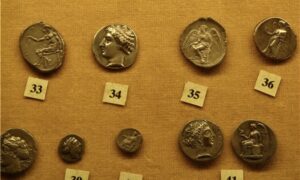
In the museum of the city of Pella, in present-day Greece, coins lie beneath glass. This is not a poetic image and not “romance of antiquity.” It is a cold reminder of something that once functioned as an infrastructure of power: accounting, tax, army, law, recognition. Today these objects govern nothing. They lie in a display case and remain silent.
It is precisely this silence that makes the museum about the future of money rather than its past. The museum shows the final state of any monetary form: when the system that compelled recognition disappears, the sign remains an object.
The name of the place must be stated directly: the Archaeological Museum of Pella — a museum located on the site of the ancient city.
Alexander as a human being, not a legend
Alexander of Macedon was born approximately 2,380 years ago and lived about 32 years. In conventional historical notation this is 356–323 BCE.
Here lies the key to understanding. Almost everything called his era fit into a single short human life, and into its active part lasting only a few years. His rule and campaigns were not a century-long construction. They were a rapid project of expansion, retention, and redistribution of power.
The important element is not the pathos of conquest but scale expressed in modern units. The territory of his state is estimated at about 5.2 million square kilometers.
If measured from Pella to the eastern regions where the campaigns ended toward India, the straight-line distance is about 4,500 kilometers. The real path of the army, through roads, detours, and logistical routes, was inevitably longer.
This must be said in simple terms. Imagine a person who lived 32 years and within one lifetime initiated the movement of troops, people, taxes, metal, and commands across distances measured in thousands of kilometers. When this is held in mind, the coins in the display cease to be “interesting metal.” They become traces of a managed system.
Coin as an instrument of power, not metal
Gold and silver in such systems were not “money by themselves.” A coin functioned because a regime of recognition existed that made it both obligatory and useful. It was accepted not out of love for metal, but because behind it stood army, law, tax, punishment, and benefit.
From this follows a thought rarely stated directly: gold does not disappear. The obligation to accept it disappears.
When Alexander died, his political construction began to disintegrate. The metal did not vanish. The coins did not vanish. What vanished was the unified authority that made them a universal language of settlement. That is why today these coins lie in a museum as objects rather than as money.
Money of our time is a network of obligations
Modern money is fundamentally different and in this sense more honest. It does not attempt to be metal. It is a record within a system of obligations.
A deposit is the bank’s obligation to the client.
A loan is the client’s obligation to the bank.
A payment is a change of record within an infrastructure recognized by participants and enforced by law.
Physical gold in such an architecture is inconvenient not because it is bad. It is inconvenient because it is “not in format.” It is nobody’s obligation, not embedded in payment infrastructure, requires physical storage, and raises questions of origin and responsibility. For this reason, in most countries commercial banks do not work with physical metal: they are not obliged to transform an object into a legally clean record if it is outside their business model.
Why people still return to gold
Almost every crisis of trust in money produces the same psychology: a person looks for an object that can be placed on the table and called real. Gold perfectly fits this symbolic role. But here an error arises: the object begins to be perceived as a substitute for the system.
Historically, gold never replaced a system. It was used inside a system as a convenient carrier of trust while authority ensured recognition of the sign. When authority disappears, metal remains. This is seen more clearly in a museum than in any theory.
Where COSMIC stands
COSMIC is not an alternative currency and does not compete with banks. It operates on another level because it answers a different question.
Money answers the question of settlement within an operating system: how to pay, account, compel, distribute.
COSMIC answers the question of preservation that arises when systems change: what must be fixed so as not to disappear together with the next form of money.
If money is the language of obligations, then COSMIC is the language of continuity.
Material form here does not function as “money” but as a carrier of memory and measure that survives the replacement of any monetary оболочка.
Final
The museum in Pella shows a simple thing — without moralizing and without slogans. Any monetary form is mortal. Metal survives the form. Record survives metal. Meaning survives record.
When a system no longer understands gold, this does not mean gold has lost meaning. It means the system has changed its language. And the coins under glass lie not as the past but as a warning: what seems eternal today becomes an exhibit tomorrow.
Author:
Anonymous Architect
February 15, 2026