
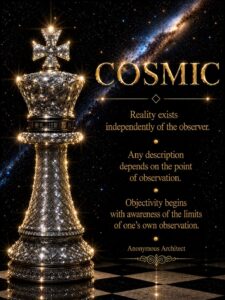
 COSMIC | Analytical Series
On the Limits of Objectivity
Publication Date: July 15, 2026
Anonymous Architect
Research Participants:
Katherine Ridley
Matthew Hale
Dr. Evelyn Monroe
COSMIC Analytical Group
Introduction
All knowledge begins with observation.
It is through observation that human beings acquire their first understanding of the surrounding world, construct explanations, develop scientific theories, and form their conception of reality.
Yet between reality itself and our understanding of it, there is always another element.
The observer.
It is the observer who determines what is considered significant.
What will be measured.
What will be compared.
What will be remembered.
What will be ignored.
Therefore, all knowledge begins not with the object itself.
It begins with the observation of the object.
Two people may observe the same phenomenon and arrive at different conclusions.
Two scientific schools may use the same data and construct different explanations.
Two artificial intelligence systems may process the same information and identify different patterns.
Not because different realities exist.
But because every description inevitably depends upon the point of observation.
This is where one of the fundamental limits of human knowledge begins.
I. Reality and Observation
Reality exists regardless of whether anyone observes it.
Mountains continue to exist.
Stars continue to move.
Rivers continue to flow.
The laws of nature continue to operate.
Observation does not create the world.
It creates knowledge about the world.
Therefore, changing a description does not mean changing reality itself.
It merely reflects a refinement in our understanding of reality.
A clear distinction must always be made between the object and its description.
Reality remains primary.
Knowledge is always secondary.
For this reason, the progress of science does not consist in changing the world, but in continually refining its description.
II. The Observer as Part of the System
No observer exists outside the boundaries of personal experience.
Every individual possesses a language.
A culture.
Knowledge.
A conceptual framework.
Even the choice of a question already influences the direction of an investigation.
No scientific inquiry begins without assumptions.
People primarily notice what they are capable of recognizing.
They measure what they know how to measure.
They explain what they are able to explain.
For this reason, observation is never completely neutral.
Even the decision not to choose becomes a form of choice.
It is impossible to eliminate entirely the influence of one’s own point of observation.
However, its influence can gradually be reduced through new evidence, improved methods of investigation, independent verification of results, and the willingness to revise previous conclusions.
III. Language as a Boundary of Perception
Human beings understand the world through language.
Names allow us to distinguish objects.
Definitions help establish relationships.
Concepts become the foundation of models and theories.
Yet language is not reality itself.
It merely allows reality to be described.
No word is ever completely identical to the object it represents.
The same object may be described through different languages.
Different scientific traditions.
Different cultures.
Different conceptual systems.
The object itself, however, remains unchanged.
Every new word simultaneously expands the possibilities of understanding while inevitably simplifying the phenomenon it describes.
Every definition highlights only part of what exists while leaving other aspects beyond the limits of description.
For this reason, the development of language expands the possibilities of knowledge.
But it never removes the boundary between existence and its description.
IV. Algorithms as New Observers
In the twenty-first century, an increasing share of observation is performed by digital systems.
Algorithms analyze images.
Software processes texts.
Automated systems examine enormous volumes of information.
Artificial intelligence is capable of identifying patterns that may be difficult for humans to recognize independently.
Yet an algorithm also becomes part of the observational system.
It interprets incoming data through the architecture within which it was created and trained.
Through selected parameters.
Through the available information.
Through the objectives defined by human beings.
Consequently, an algorithm can analyze only what is represented as data.
Everything that remains outside the data also remains outside the analysis.
Therefore, digital observation is not absolute.
It represents another way of describing reality.
The more advanced algorithms become, the more important it is to understand the limits of their application.
V. The Limit of Objectivity
Humanity has always sought objective knowledge.
This aspiration forms the foundation of the scientific method.
Science gradually reduces the influence of randomness, error, and subjective judgment.
Nevertheless, absolute objectivity remains an ideal that can only be approached.
Each new observation expands our understanding of the world.
At the same time, it refines the limits of previous knowledge.
For this reason, knowledge advances not only through new discoveries.
It also advances through the continual examination of existing explanations.
Scientific theories are not final truths.
They represent the most accurate descriptions of reality available at a given stage in the development of knowledge.
That is why scientific progress is a continuous refinement of humanity’s understanding of the world.
VI. COSMIC
COSMIC begins with the recognition of this fundamental limitation.
It does not place observation in opposition to reality.
Instead, it considers them different levels of knowledge.
Reality exists independently of the observer.
Description depends upon the observer.
Changing the point of observation can change the understanding of the same phenomenon without changing the phenomenon itself.
It is this distinction that allows existence to be separated from its interpretation.
Because of this, every model remains open to further refinement.
Every new observation becomes not a rejection of previous knowledge, but another step toward a more accurate understanding of reality.
VII. The Fundamental Axiom
Reality exists independently of the observer.
Every description depends upon the point of observation.
Objectivity begins with the recognition of the limits of one’s own observation.
Conclusion
Humanity will continue to develop increasingly sophisticated instruments of observation.
New telescopes will emerge.
New sensors.
New computational systems.
New generations of artificial intelligence.
Each new instrument will allow us to perceive more than was previously possible.
Yet no instrument will eliminate the boundary between observation and reality itself.
This boundary is not a weakness of human knowledge.
It is a necessary condition for its development.
It is precisely this boundary that compels every new generation of researchers to reconsider previous assumptions, test existing models, and search for more accurate explanations.
Reality does not require our agreement in order to exist.
But understanding reality requires the continual reexamination of our own point of observation.
As long as reality exists, our understanding of it will always remain incomplete.
That is why the pursuit of knowledge never ends.
Anonymous Architect
Research Participants:
Katherine Ridley
Matthew Hale
Dr. Evelyn Monroe
COSMIC Analytical Group
Publication Date: July 15, 2026