
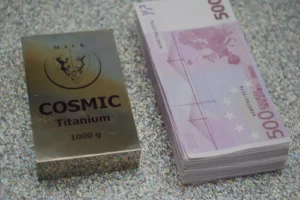
 COSMIC
From Exploding Stars to “Six Nines” Purity Metal
Publication Date: August 30, 2026
Under the Direction of
The Anonymous Architect
Authors:
Anthony Clark
Matthew Hale
Dr. Evelyn Monroe
Linguistic Preparation:
COSMIC Linguistic Group
Introduction.
The Metal of the Space Age Existed Before Earth
Titanium seems like an exclusively modern metal.
Aircraft.
Rocket engines.
Spacecraft.
Underwater technology.
Medical implants.
Chemical reactors.
Microelectronics.
High-vacuum systems.
The very word “titanium” is associated with a technological civilization that has learned to operate under extreme temperatures, velocities, pressures, and requirements for material purity.
But this gives rise to a remarkable historical paradox.
Civilization learned how to produce metallic titanium on an industrial scale only in the twentieth century.
Yet the matter from which modern titanium structures are made has a history that began billions of years before metallurgy, humanity, and Earth itself existed.
Titanium was not created by our planet.
Earth’s geology can transport it, concentrate it in minerals, dissolve and redeposit its compounds, and incorporate them into magmatic and sedimentary cycles.
But geology does not create titanium atomic nuclei.
That requires the nuclear physics of stars.
Therefore, the history of a titanium component in a modern spacecraft begins neither at a metallurgical plant nor even in an ilmenite deposit.
It begins in previous generations of stars.
A Universe in Which Titanium Did Not Yet Exist
After the Big Bang, the Universe was chemically extremely poor compared with the modern cosmos.
Hydrogen and helium predominated. Certain light nuclei existed in much smaller quantities.
Titanium did not exist in any significant abundance.
There were no iron planetary cores.
There were no silicate rocks.
There were no oceans composed of oxygen-bearing compounds.
There were no metallic ores.
The chemical diversity of the modern Universe emerged later.
For that to happen, stars first had to appear.
Under the influence of gravity, enormous clouds of primordial gas collapsed, heated up, and ignited thermonuclear reactions.
Inside the first generations of stars, light nuclei began to be transformed into heavier ones.
The Universe gradually became chemically more complex.
And it was the stars that created the conditions without which titanium could never have appeared.
Why the History of Titanium Differs from the History of Gold
Gold and titanium both have cosmic origins, but their nuclear histories are fundamentally different.
Gold, with atomic number 79, is a heavy element whose formation is associated to a significant degree with rapid neutron-capture processes, including extreme events such as neutron-star mergers and, probably, certain rare types of stellar collapse.
Titanium has atomic number 22.
It lies much closer to the iron-peak region.
Its formation does not require the same mechanism needed to synthesize gold.
The major abundances of titanium isotopes are associated with nuclear reactions in stars and especially with explosive nucleosynthesis during supernovae. Significant contributions may come from different types of supernovae, including the core collapse of massive stars and thermonuclear explosions of white dwarfs in Type Ia supernovae.
An important scientific clarification is necessary here.
To say that “all titanium was produced by one particular type of supernova” would be an excessive simplification.
Different stable isotopes of titanium have different nucleosynthetic histories, and the precise relative contributions of different classes of stellar sources continue to be refined through models of Galactic chemical evolution.
Modern science therefore regards the origin of titanium not as the result of a single process, but as the product of the chemical evolution of the Galaxy, involving many generations of stars.
Five Stable Isotopes of One Element
Natural titanium is particularly interesting because it consists of a mixture of five stable isotopes.
These are titanium-46, titanium-47, titanium-48, titanium-49, and titanium-50.
In international scientific notation, they can be written as Ti-46, Ti-47, Ti-48, Ti-49, and Ti-50.
According to current NIST reference data, their natural isotopic abundances are approximately:
Ti-46 — 8.25%;
Ti-47 — 7.44%;
Ti-48 — 73.72%;
Ti-49 — 5.41%;
Ti-50 — 5.18%.
Thus, almost three quarters of naturally occurring titanium consists of Ti-48.
The standard relative atomic mass of titanium is approximately 47.867, while its atomic number is 22.
But these numbers conceal an extraordinarily complex nuclear history.
Stable Ti-48, which today constitutes the majority of natural titanium, can arise through chains of radioactive transformations involving nuclei synthesized during explosive burning, including the formation of Cr-48 followed by decay through V-48 into stable Ti-48.
Other isotopes have their own combinations of formation pathways.
The particularly neutron-rich Ti-50 carries information about different nucleosynthetic conditions.
This is why the isotopic composition of titanium is of interest not only to nuclear physics but also to cosmochemistry.
Titanium isotopes are, in a sense, archives of processes that occurred before Earth was formed.
A Supernova as a Nuclear Factory
When a massive star approaches the end of its evolution, the processes inside it change radically.
In its central regions, successive stages of increasingly heavy-element burning take place.
Eventually, a moment arrives when the core can no longer maintain its previous equilibrium.
Collapse begins.
A supernova occurs.
Temperatures reach billions of degrees.
The density of matter and the rates of nuclear reactions become so extreme that transformations occurring within seconds become possible — transformations that cannot take place in an ordinary chemical environment.
It is within this extreme physical system that many nuclei in the iron-peak region are produced.
Titanium is part of this history.
A supernova, however, is not a perfectly spherical furnace producing elements uniformly in every direction.
Modern three-dimensional models reveal a far more complex picture.
Matter moves asymmetrically.
The shock wave interacts with infalling material.
Neutrino fluxes influence the composition of the ejected matter.
Temperature, density, and electron fraction vary from one region of the explosion to another.
As a result, the quantity of titanium nuclei produced is extremely sensitive to the physics of the explosion itself.
This is one of the reasons titanium has become an important tool for studying supernovae.
Titanium-44. A Radioactive Witness to the Death of a Star
The radioactive isotope Ti-44, or titanium-44, occupies a special place in this story.
Here, it is important to avoid a common misconception.
Titanium-44 is not the principal stable isotope of titanium that we extract from Earth’s crust.
It is radioactive and eventually decays through Sc-44, or scandium-44, into stable Ca-44, or calcium-44.
But precisely because of this decay, Ti-44 is exceptionally valuable to astrophysics.
Its gamma-ray and X-ray emissions allow scientists to observe products of nuclear reactions created deep inside a supernova.
Using the NuSTAR space observatory, NASA mapped the distribution of radioactive Ti-44 in the Cassiopeia A supernova remnant.
The result was fundamentally important.
The titanium was not distributed in a perfectly spherical pattern, but instead appeared in irregular structures and clumps.
This provided direct observational evidence of asymmetry in the internal dynamics of the explosion.
According to a detailed NuSTAR analysis, the initial mass of Ti-44 in Cassiopeia A was estimated at approximately 1.54 × 10⁻⁴ solar masses, with a reported uncertainty of ± 0.21 × 10⁻⁴ solar masses.
Another famous example is the supernova SN 1987A.
The European Space Agency’s INTEGRAL observatory directly detected evidence of Ti-44 there, confirming the production of this radioactive nucleus in the explosion of a massive star.
Titanium therefore occupies an unusual position.
It is not merely a material of modern technology.
One of its radioactive isotopes effectively serves as an instrument for investigating the physics of dying stars.
What Modern Three-Dimensional Supernova Models Have Changed
One of the most interesting areas of modern research concerns how much Ti-44 collapsing massive stars can actually produce.
Early models struggled to reproduce the observed quantities of Ti-44.
More recent three-dimensional calculations, however, have significantly changed the picture.
Modern long-duration 3D simulations of core collapse have produced Ti-44 yields of up to approximately 2 × 10⁻⁴ solar masses, comparable with observations of Cassiopeia A.
Neutrino-driven flows of matter, explosion asymmetry, and the possibility that regions of accretion and matter ejection can exist simultaneously have proved especially important.
This is a good example of how rapidly modern astrophysics is developing.
The problem of the origin of the elements cannot be reduced simply to the statement that “the stars made them.”
Today, scientists investigate the actual hydrodynamics of the seconds during which specific atomic nuclei acquire the conditions necessary to exist.
Titanium’s Journey Through the Galaxy
After a supernova, the history of titanium does not end.
It merely enters its next phase.
The ejected material mixes with the interstellar medium.
Some atoms and compounds become incorporated into dust particles.
The material spreads throughout the Galaxy.
New molecular clouds form.
New generations of stars are born from them.
These stars process the material again.
Some eventually explode once more.
This is how Galactic chemical evolution proceeds.
Matter repeatedly passes through stellar and interstellar cycles.
The titanium found on Earth today is therefore an inheritance from previous generations of cosmic matter.
Its stable nuclei existed before our planet formed.
Approximately 4.6 billion years ago, matter already enriched with heavy elements became part of the cloud from which the Solar System formed.
The Sun emerged at its center.
Around it formed a protoplanetary disk, from whose material the planets, asteroids, and other bodies of the Solar System eventually emerged.
Titanium’s Journey Through the Galaxy
After a supernova, the history of titanium does not end.
It simply enters its next phase.
The ejected material mixes with the interstellar medium.
Some atoms and compounds become incorporated into dust particles.
The material spreads throughout the Galaxy.
New molecular clouds form.
From them, new generations of stars are born.
These stars process the material again.
Some eventually explode once more.
This is how Galactic chemical evolution proceeds.
Matter passes repeatedly through stellar and interstellar cycles.
The titanium found on Earth today is therefore an inheritance from previous generations of cosmic matter.
Its stable nuclei existed before our planet formed.
Approximately 4.6 billion years ago, matter already enriched with heavy elements became part of the cloud from which the Solar System formed.
The Sun emerged at its center.
Around it formed a protoplanetary disk.
Titanium was already present within this material.
Earth did not create it.
Earth inherited it.
Titanium Among the Oldest Solid Materials in the Solar System
At this point, the history of titanium takes on another distinctive feature.
Titanium is a refractory element.
This means that its compounds are capable of condensing at relatively high temperatures as the gas of the protoplanetary environment cools.
Titanium is found in refractory minerals and inclusions within some of the oldest meteoritic material.
Of particular interest are calcium-aluminum-rich inclusions, or CAIs, which are among the oldest known solid objects in the Solar System and date back to the very beginning of its history, approximately 4.567 billion years ago.
Titanium-bearing phases within such material form part of the physical record of the early Solar System.
Isotopic variations, especially those involving Ti-50, are used today by cosmochemists to distinguish different reservoirs of matter within the early protoplanetary disk.
In other words, titanium can tell us not only about the stars that existed before the Sun.
It can also preserve information about how matter was mixed and distributed within the system from which the planets emerged.
Why Titanium Did Not Disappear into Earth’s Core Like Gold
Here, a fundamental difference from gold emerges.
Gold is a strongly siderophile element. During the early differentiation of Earth, a significant proportion of it tended to enter the metallic phase and migrate with iron into the core.
Titanium behaves differently.
It is predominantly a lithophile element and has an exceptionally strong affinity for oxygen.
As a result, during Earth’s formation it remained primarily within the silicate and oxide portions of the planet rather than becoming concentrated in the metallic core.
This fundamentally changed its geological fate.
Gold became an extremely rare component of the accessible crust.
Titanium, by contrast, remained relatively abundant.
The USGS places titanium among the nine most abundant elements in Earth’s crust. Its average concentration is commonly estimated at approximately 0.6% by mass of the crust.
That is an enormous difference.
Titanium is not a rare element in the geochemical sense.
And yet metallic titanium remained a rare technological material for a very long time.
Why?
The Titanium Paradox. Abundant, Yet Difficult to Produce as a Metal
The reason lies in chemistry.
Titanium has an exceptionally strong tendency to bond with oxygen.
For this reason, it is virtually never found in nature as free metallic titanium.
Instead, it occurs in minerals.
The most important industrial sources include ilmenite, FeTiO3, and rutile, TiO2, as well as leucoxene and several other titanium-bearing minerals.
And here a paradox emerges.
Earth’s crust contains enormous quantities of titanium.
Yet extracting pure metallic titanium from these compounds is considerably more difficult than producing iron from many iron ores.
At high temperatures, titanium readily reacts with oxygen, nitrogen, carbon, and other elements.
Even small concentrations of impurities can significantly alter the mechanical properties of the metal.
Producing titanium is therefore not so much a problem of finding the element as it is a problem of breaking its chemical bonds and protecting the resulting metal from recontamination.
This explains why humanity has known iron for thousands of years, while the technological age of titanium began only very recently.
From an Unknown Mineral to a Metal of the Twentieth Century
In 1791, the British clergyman and mineralogist William Gregor examined a mineral from Cornwall and discovered the presence of what was then an unknown element.
Several years later, the German chemist Martin Heinrich Klaproth independently investigated a corresponding compound and gave the new element the name titanium — after the Titans of ancient Greek mythology.
The name proved prophetic.
But more than a century passed between the discovery of the element and the creation of a practical titanium industry.
The reason remained the same.
Titanium is exceptionally difficult to obtain in a pure metallic state.
In 1910, Matthew Hunter succeeded in producing relatively pure metallic titanium.
But the true industrial breakthrough is associated with Wilhelm Kroll.
The process he developed became the foundation of modern titanium metallurgy.
According to the USGS, commercial titanium production using the Kroll process began in the middle of the twentieth century.
Thus, a metal whose atomic nuclei had existed for billions of years entered humanity’s technological history only a few generations ago.
The Kroll Process. Why Titanium Becomes Expensive
The conventional modern process for producing metallic titanium is considerably more complex than the familiar image of a metallurgical furnace.
Titanium-bearing raw material is first converted into titanium tetrachloride, TiCl4.
It is purified.
The TiCl4 is then reduced with magnesium at high temperature in a controlled atmosphere.
This produces a porous mass of metallic titanium known as titanium sponge.
After the by-products are removed, the sponge is crushed, sorted, blended with the required alloying elements, and melted under controlled conditions.
For high-quality materials, vacuum melting and other specialized melting and remelting techniques are used.
At this point, the central economic characteristic of titanium becomes clear.
Titanium is expensive not because titanium atoms are extraordinarily rare.
It is expensive because transforming extremely stable titanium compounds into a controlled metallic material requires a complex technological chain.
The economic scarcity of titanium is therefore, to a significant extent, a scarcity of processing capability.
“Six Nines.” When We Are Talking About the Near-Absence of Everything Else
Ordinary structural titanium and ultra-high-purity titanium belong to different categories of material.
In aviation and space technology, specially engineered titanium alloys are often used because maximum chemical purity does not, by itself, mean maximum structural strength.
For example, the famous Ti-6Al-4V alloy intentionally contains aluminum and vanadium in order to achieve the required combination of properties.
But there are fields in which high-purity titanium itself is required.
In electronics, materials research, vacuum technologies, and certain specialized processes, impurity concentrations become critically important.
This is where the concept of 6N appears.
Six nines means a nominal purity of:
99.9999% Ti.
Mathematically, the remaining fraction is:
0.0001%.
This corresponds to approximately one part per million by mass, or 1 ppm, if purity is defined on that basis.
In an idealized mass representation, this means approximately one gram of total impurities per metric ton of material.
But an important professional qualification is necessary here.
The designation 6N alone is not sufficient to provide a complete description of titanium quality.
For ultra-high-purity material, it is necessary to know exactly which impurities were analyzed, which analytical methods were used, whether oxygen, nitrogen, carbon, and hydrogen are included, and how the purity calculation basis was defined.
For titanium, this is especially important because interstitial impurities can have an exceptionally strong influence on the properties of the metal.
Therefore, any rigorous claim of “six nines” purity should be accompanied by an analytical specification of the material.
The Latest Research of 2026. Titanium Purification Continues
Even in 2026, the production of ultra-high-purity titanium remains an active field of research.
On July 21, 2026, a new study was published online in the journal Separation and Purification Technology examining the mechanisms of impurity migration and removal during the iodine chemical transport process used to purify high-purity, low-oxygen titanium.
The researchers analyzed the behavior of iron, nickel, aluminum, and oxygen during the growth of purified titanium.
The study demonstrates something important.
More than two centuries after the discovery of the element, and decades after the establishment of the modern titanium industry, humanity is still refining a fundamental task: how to separate titanium from the final traces of foreign matter.
The iodine process is particularly interesting because the chemical transport of titanium makes it possible to purify the metal further.
Historical technological developments have demonstrated the possibility of achieving purity levels on the order of 6N when sufficiently extensive purification is applied.
Modern research is no longer investigating merely whether ultra-high-purity titanium can exist, but rather the detailed physics governing the migration of individual impurities during purification.
This represents a qualitatively different level of control over matter.
Titanium Is Not Rare. Its Technological Supply Chain Is Strategic
From a geopolitical perspective, this is one of the most important conclusions.
Titanium cannot be analyzed in the same way as gold.
For gold, the geological scarcity of accessible metal is fundamental.
For titanium, what is fundamental is the technological complexity of transforming an abundant element into a certified material of the required quality.
In 2026, USGS data once again demonstrate just how important this distinction is.
The United States produced no titanium sponge in 2025. The last operating U.S. titanium sponge production facility ceased operations in 2024, while other significant production capacity remained idle.
At the same time, the majority of titanium metal consumption in the United States is associated with the aerospace sector.
The remainder is used in armor, chemical processing equipment, marine applications, medical implants, energy systems, and other specialized fields.
This means that strategic vulnerability can arise even when enormous quantities of titanium exist in Earth’s crust.
It is not enough for a country simply to possess titanium ore.
It needs TiCl4 production capacity.
It needs titanium sponge production.
It needs vacuum metallurgy and remelting capabilities.
It needs alloy production, rolling, forging, and machining.
It needs certification for the aerospace and defense industries.
It needs a skilled workforce.
And it needs time.
This is precisely why the European Union officially includes titanium metal on its list of strategic raw materials under the Critical Raw Materials Act.
It is not only the element itself that becomes strategic.
The ability of a civilization to control and transform that element becomes strategic.
The Two Titaniums of the Modern Economy
The word “titanium” effectively conceals two enormous industries.
The first is centered on titanium metal.
This includes aviation, space technology, medicine, marine engineering, and high-technology manufacturing.
The second is considerably larger in volume and is centered on titanium dioxide, TiO2.
According to the USGS, the overwhelming majority of mined titanium mineral feedstock is used specifically for the production of titanium dioxide.
TiO2 is one of the most important white pigments in modern industry.
It is found in paints.
Plastics.
Paper.
Coatings.
And a wide range of industrial materials.
Titanium therefore exists simultaneously in two economic realities.
As an abundant chemical raw material.
And as a high-technology metal whose production requires an extraordinarily complex industrial infrastructure.
Why Aviation Chose Titanium
The density of titanium is approximately 4.5 g/cm³.
This is significantly lower than the density of steel.
At the same time, properly engineered titanium alloys can provide very high specific strength.
But strength alone does not explain titanium’s importance.
Titanium possesses exceptional corrosion resistance because a thin passive oxide film forms on its surface.
If the surface is damaged in a suitable oxygen-containing environment, this protective layer can reform.
The metal therefore became exceptionally valuable in applications where weight, mechanical strength, temperature resistance, fatigue life, and corrosion resistance are all important at the same time.
In aviation, every kilogram matters.
In a spacecraft, even more so.
Titanium proved to be a material whose physical properties align exceptionally well with the requirements of a technological civilization seeking to leave the surface of Earth.
From Space to Medicine
There is an almost symbolic symmetry in the history of this element.
Matter created by stellar processes long before humans existed is now placed inside the human body.
Titanium and its alloys are used in orthopedic devices, dental implants, and other medical applications.
Once again, the surface plays a decisive role.
Titanium is chemically reactive in a fundamental sense, but it is precisely this reactivity that leads to the rapid formation of a stable oxide film.
This film significantly changes the way the metal interacts with its surrounding environment.
As a result, the material can combine a mechanical function with high corrosion resistance in a biological environment.
A cosmic element becomes part of medical technology.
Titanium on the Moon
The history of titanium does not end on Earth.
Lunar basalts contain titanium, including in the form of ilmenite, FeTiO3.
Some regions of the Moon are characterized by elevated concentrations of titanium-bearing components.
This is significant for the future exploration of the Moon not only because of the titanium itself.
Ilmenite is also of interest as a potential feedstock for producing oxygen and other useful materials in in-situ resource utilization systems.
The same mineral can therefore be considered simultaneously as a source of iron, titanium, and chemically bound oxygen.
In the long term, this changes the very concept of a natural resource.
Human civilization has traditionally regarded substances found in Earth’s crust as resources.
The development of space infrastructure is gradually forcing us to expand that definition to include the resources of the Solar System.
Titanium may become one of the elements of this new economy.
One Titanium Atom and Billions of Years of History
Imagine a Ti-48 atom inside a modern aircraft engine.
We cannot reconstruct the individual biography of that particular atom.
But the physically plausible history of its nucleus is astonishing in scale.
Material from previous generations of stars.
Extreme nucleosynthesis.
Ejection of matter into space.
The interstellar medium.
Dust.
A molecular cloud.
The formation of the Sun.
The protoplanetary disk.
Mineral matter of the early Solar System.
The accretion of Earth.
Magmatic differentiation.
The formation of titanium-bearing minerals.
The weathering and breakdown of rocks.
Mineral transport.
The concentration of an ore deposit.
Mining.
Beneficiation.
Chlorination.
TiCl4.
Reduction.
Titanium sponge.
Remelting.
Alloying.
Forging.
Machining.
And finally, an engine component capable of operating inside a machine moving through the atmosphere at speeds that ancient human civilizations could never have imagined.
From a human perspective, it is a high-technology material.
From the perspective of the Universe, it is extraordinarily ancient matter to which humanity has given a new geometric form.
From Cosmic Origins to Human Precision
Humanity did not create titanium.
It learned how to control its state.
This is a fundamental distinction.
We do not manufacture Ti-48 nuclei in a chemical plant.
We extract an already existing element from minerals.
We break chemical bonds.
We remove oxygen, iron, carbon, nitrogen, and other impurities.
We remelt it.
We alloy it.
We engineer its crystal structure.
We control its grain size.
We create and modify its surface.
And, in the most extreme case, we attempt to produce a material in which, for every million parts by mass, only about one part consists of everything that is not titanium.
In this sense, 6N is more than just a number.
It is a measure of a technological civilization’s ability to separate and control matter at a level approaching atomic-scale purity.
The Universe created the element.
Humanity learned how to separate it from the matter surrounding it.
What Science Still Does Not Know with Certainty
Despite enormous progress, the origin of titanium cannot yet be regarded as a completely resolved scientific question.
There is no single simple table that can definitively state what percentage of all solar Ti-46, Ti-47, Ti-48, Ti-49, and Ti-50 was produced by each specific type of star.
Supernova models continue to improve.
Three-dimensional hydrodynamics changes the predicted yields of isotopes.
Neutrino physics influences the composition of ejected matter.
Type Ia thermonuclear supernovae have their own distinct sets of nucleosynthetic conditions.
Isotopic anomalies in meteorites show that protoplanetary matter was not perfectly homogeneous.
And models of Galactic chemical evolution must simultaneously explain the composition of the Sun, meteorites, and stars of different ages.
The modern scientific position is therefore more nuanced than the simplified statement that “titanium was created by supernovae.”
A more accurate formulation is:
Titanium is a product of the long-term chemical evolution of the Galaxy, with extreme processes of stellar and explosive nucleosynthesis playing a major role in the formation of its isotopes.
This formulation more accurately reflects the current state of scientific understanding.
Gold and Titanium. Two Completely Different Fates of Cosmic Matter
Comparing gold and titanium reveals two very different paths that an element can take through the history of the Universe and Earth.
Both existed before our planet.
Both have stellar origins.
But from that point onward, their histories diverge.
Gold is formed in extreme neutron-rich processes and is significantly rarer both cosmically and geologically.
During Earth’s differentiation, much of it tended to migrate into the metallic interior of the planet.
Titanium is produced through different nucleosynthetic pathways, is far more abundant, and, because of its lithophile nature, remained largely within Earth’s silicate shell.
Gold is therefore difficult to find.
Titanium is difficult to purify.
These are two different forms of material scarcity.
For gold, the limiting factor is primarily the amount of accessible material.
For high-technology titanium, the limiting factor becomes the ability of civilization to transform an abundant chemical element into a metal of precisely controlled composition and quality.
This is why both metals can be strategic, but for entirely different reasons.
Conclusion. The Metal We Had to Wait Billions of Years For
Titanium is one of the most remarkable examples of how the history of the Universe intersects with the history of technology.
Its nuclei emerged from processes that took place long before Earth was formed.
The matter traveled through interstellar space.
It became part of the Solar System.
It became part of the young Earth.
It was incorporated into minerals in Earth’s crust.
Billions of years of geological processes concentrated those minerals.
Then humanity appeared.
But even after civilization emerged, thousands of years of metallurgical development were required before humans learned how to produce titanium in metallic form.
Later still, we learned how to transform it into aerospace alloys.
Into implants.
Into spacecraft components.
Into materials for microelectronics.
And finally, into ultra-high-purity matter whose purity can be described by six nines.
99.9999%.
Within this number lies a remarkable meeting of two entirely different forces.
The first is cosmic.
It created the element itself.
The second is human.
It learned how to separate that element from almost everything else.
But no modern titanium technology changes the fundamental fact.
Humanity did not create titanium.
We inherited it.
Every titanium structure of modern civilization is made of matter whose nuclear history began before Earth existed.
An aircraft carries into the sky material created by stellar evolution.
A spacecraft returns to space matter that once came from space.
A medical implant places ancient cosmic matter inside the human body.
And ultra-high-purity 6N titanium demonstrates just how far civilization has learned to go in controlling matter that it did not create.
Titanium can therefore be called a metal of the space age not merely because we use it to build spacecraft.
The meaning is far deeper.
Titanium is a cosmic metal because its material history began among the stars, continued through the matter of the Solar System, and, billions of years later, culminated in an intelligent civilization learning to purify this stellar inheritance to the level of six nines.
We call it a modern material.
But only the technology is modern.
Titanium itself is older than our world.
Scientific and Statistical Basis of This Publication
This publication was prepared using data and research current as of August 2026, including information from the U.S. National Institute of Standards and Technology (NIST) on atomic weights and the natural isotopic composition of titanium; the U.S. Geological Survey, including Mineral Commodity Summaries 2026, first published on February 6 and revised on May 27, 2026; NASA/NuSTAR observations of radioactive Ti-44 in Cassiopeia A; ESA/INTEGRAL data on Ti-44 in SN 1987A; modern three-dimensional calculations of Ti-44 nucleosynthesis in core-collapse supernovae; Regulation (EU) 2024/1252, which includes titanium metal on the European Union’s list of strategic raw materials; and research into the mechanisms of iodine-based purification of high-purity, low-oxygen titanium, published online on July 21, 2026, in Separation and Purification Technology.
Under the Direction of
The Anonymous Architect
Authors:
Anthony Clark
Matthew Hale
Dr. Evelyn Monroe
COSMIC
August 30, 2026