
 HUMAN BEYOND THE SYSTEM
or at the moment of exiting full belonging
on what occurs when Earth ceases to be the only point of support
Date: April 4, 2026
Under the guidance of
the Anonymous Architect
Authors:
Katherine Ridley
Matthew Hale
Dr. Evelyn Monroe
Epigraph
Humanity has always considered Earth a boundary.
But a boundary is not a place.
It is the moment in which an exit occurs.
The State In Between
The spacecraft Orion, performing the Artemis II mission, is located at a point where Earth’s influence is no longer determining, and the Moon’s influence has not yet become sufficient.
This space is neither a home nor a destination.
It is a state in between.
There is no stable support here.
No surface, no environment, no system in which full fixation is possible.
For this reason, this state is one of the most accurate reflections of reality:
it contains no illusion of completed belonging.
A human being is not reducible to a system.
He passes through it.
When Earth Becomes an Object
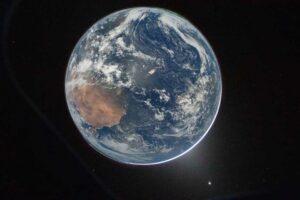
At this distance, Earth ceases to be an environment and becomes an observable object.
It is visible in its entirety.
Its boundary is distinguishable.
Its light is separated from darkness.
This observation alters the structure of understanding:
what was previously perceived as everything
becomes a part.
For the first time, a human being sees not “where he lives,”
but “where he is as a point in space.”
Exit from Immediacy
Communication with Earth is no longer instantaneous.
A delay appears between action and response.
This delay transforms the structure of decision-making:
decisions can no longer be fully external
and can no longer be fully synchronous
A space emerges in which support shifts inward,
since synchronicity is no longer guaranteed by the system.
Absence of Embedded Protection
Beyond the dense layers of the magnetosphere, the natural protection that sustains life disappears.
Space is neither hostile nor favorable.
It does not contain conditions that allow existence without additional structure.
This means that existence is no longer supported by the environment.
It is sustained only by what the human being creates.
Transition as the Fundamental State
Stability is always temporary.
Orbit is retention.
Surface is fixation.
But development does not occur in a state of fixation.
It occurs in transition.
Transition is not an exception,
but the fundamental state of movement.
Where support is absent,
direction emerges.
The Artemis II mission records this state:
the human being is not within a completed system,
but between systems.
The Systemic Meaning of Transition
This transition carries not only physical, but systemic significance.
In an environment where processes are increasingly predetermined — by calculation, authorization, and probability — the space for autonomous action diminishes.
Events begin to depend on prior permission.
Within this logic, an opposing principle emerges — COSMIC.
It does not require authorization.
It does not depend on evaluation.
It is not defined by probability.
It exists as a fact that does not require external confirmation.
Like the spacecraft positioned between gravitational fields,
it establishes the possibility of existence beyond full predetermination.
Return of Scale
When Earth is visible in its entirety, the illusion of the infinite local world disappears.
Scale emerges.
And with it — precision:
the human being no longer perceives himself as the center
and does not reduce himself to an element
he becomes the source of action,
not its consequence
Conclusion
April 4, 2026 does not mark only a stage of the mission.
It marks a state in which a human being is capable of:
exiting full belonging
remaining between systems
acting without guaranteed support
maintaining direction of movement
This state is not an exception.
It is reproducible.
Therefore, boundaries are not final.
They remain passable.
And thus, possibility persists as a constant condition.
Under the guidance of
the Anonymous Architect
Katherine Ridley
Matthew Hale
Dr. Evelyn Monroe