
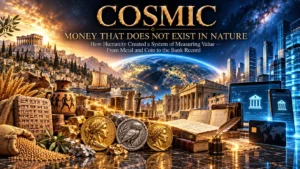
 COSMIC | Analytical Series
MONEY THAT DOES NOT EXIST IN NATURE
How Humanity Created a System for Measuring Value — from Metal and Coin to the Bank Record
Publication Date: September 30, 2026
Under the Direction of: Anonymous Architect
Authors
Dr. Adrian Whitmore — United Kingdom
Monetary History & Institutional Development
Dr. Matthias Keller — Germany
Monetary Systems & Economic History
Prof. Elena Markou — Greece Ancient
Economy & Coinage
Dr. Sofia Almeida — Portugal
European Trade & Monetary Networks
Dr. Catherine Reynolds — United States
Banking, Credit & Modern Monetary Institutions
Dr. Claire Beaumont — Canada
Currency, Trust & Financial Institutions
Dr. Alexander Reid — Australia
Monetary Transition & Digital Systems
Linguistic Preparation: COSMIC Linguistic Group
Introduction.
A Thing That Does Not Exist in Nature
Gold exists on Earth.
Silver exists.
Copper, iron, water, land, grain, and energy exist.
But the dollar does not exist in nature.
The euro does not exist in nature.
The pound sterling does not exist in nature.
Nor did the denarius, florin, ducat, thaler, mark, or peseta exist until human beings created systems within which a particular metal, coin, document, or record came to be recognized as a means of settlement and a unit of value.
This is a fundamental distinction.
Gold exists independently of whether human beings recognize it or not. A monetary unit exists only within a human-created social, legal, and institutional system.
For this reason, the history of money is far more than the history of coins and banknotes.
It is the history of one of the most far-reaching abstractions ever created by Homo sapiens.
Over thousands of years, human beings learned to measure value, transfer economic claims across time and space, express them numerically, link them to metal, record them on paper, and ultimately store them in the form of an electronic bank record.
To understand what money is today, we must begin with an era in which money as we know it did not yet exist.
I. Before Coinage
For most of the existence of Homo sapiens, there were no national currencies, no banks, no banknotes, and no central banks.
But this does not mean that all economic relations were reduced to the primitive exchange of one object for another.
Direct exchange did exist, but alongside it human communities used mutual obligations, debt, resource distribution, gift exchange, and various forms of accounting.
Therefore, the popular formula “first there was barter, then money appeared” is too simplistic to describe actual history.
Monetary functions emerged gradually.
Direct exchange presents an obvious problem.
One person has grain and needs an animal. But the owner of the animal does not need grain at that particular moment.
If a transaction is possible only when needs coincide directly, the possibilities for exchange become severely limited.
This creates a need for objects and systems through which value can be measured, preserved, or transferred.
Different societies used livestock, grain, shells, textiles, metals, and many other objects for these purposes.
But something even more important was taking place.
Humanity gradually learned to separate the concept of value from the specific object itself.
This is where the history of money as an abstraction begins.
II. When Value Became a Number
A developed monetary system is impossible without the ability to count and keep records.
How much was transferred?
How much was received?
Who owns what?
Who owes whom?
When must the obligation be fulfilled?
Long before modern currencies, human societies were already capable of expressing economic relationships in terms of quantity.
Grain can be measured.
Livestock can be counted.
Metal can be weighed.
Debt can be recorded.
An obligation can be carried into the future.
An extraordinarily important phenomenon emerges — economic memory.
If one person transfers property to another today, while the reciprocal obligation is to be fulfilled later, exchange no longer has to be completed at the moment when physical objects change hands.
Economic relations acquire a temporal dimension.
Value becomes more than a thing.
It becomes a relationship between people.
III. Metal
Metals possessed a number of qualities that made them especially convenient carriers of value.
They are durable, divisible, can be melted down, are relatively easy to transport, exist in limited quantities, and their quality can be tested.
Gold and silver, because of their physical properties and relative scarcity, came to occupy a special position in many monetary systems.
Before the emergence of struck coinage, metal could be used by weight.
In such a world, value remained closely tied to substance.
But settlement in metal created a practical problem.
Weight had to be checked.
Quality had to be determined.
Purity had to be established.
Measurement had to be trusted.
The next major step in monetary history addressed precisely this problem.
IV. Coinage: The Standardization of Value
Around the 7th century BCE, some of the earliest known struck coins appeared in Lydia, in the western part of Asia Minor.
Early Lydian coins were made of electrum — a naturally occurring alloy of gold and silver — and were issued according to established weight standards.
A fundamental change had taken place.
What now stood before a person was no longer a random piece of metal.
The weight had been standardized.
A mark was placed on the metal.
Behind that mark stood an issuer.
The coin united substance, measure, and authority.
Trust could now shift from the direct weighing of metal to a standardized monetary object.
This was a major step in the history of economic coordination.
V. Ancient Greece: Money Becomes a System
The Greek city-states widely developed coin circulation.
The coin became simultaneously an economic instrument, a sign of origin, and an expression of political identity.
Athenian silver coins bearing the image of Athena and the owl became widely circulated throughout the Mediterranean world.
This demonstrated another fundamental property of money.
A monetary object can function far beyond the territory in which it was issued, if participants in trade trust its characteristics and origin.
Particularly interesting was the development of bronze coinage.
Its monetary function could significantly exceed the immediate value of the metal contained in it.
It is precisely here that the transition from money as substance to money as a recognized sign of value becomes especially visible.
In a certain sense, the history of future fiat money begins long before the appearance of the paper banknote.
VI. Money and the State
As states grew, monetary systems became part of the infrastructure of governance.
Taxes could be expressed in money.
Armies could be paid in money.
Government expenditures could be calculated in money.
Through a single monetary unit, it became possible to compare goods and services produced in different regions.
The Roman monetary system is one of the best-known examples of the scaling of monetary space.
But ancient monetary systems also demonstrated another pattern.
State authorities could alter the precious metal content of a coin.
Consequently, nominal value and physical content no longer necessarily had to be identical.
Between substance and monetary value, a space emerged for political and institutional decision-making.
VII. The Medieval World: From Coin to Obligation
After the fall of the Western Roman Empire, the very idea of money did not disappear.
Coinage systems fragmented, changed, and coexisted.
Different territories used different coins, weight standards, and systems of account.
The expansion of trade required mechanisms capable of connecting these systems. Gradually, the importance of credit, banking operations, and written obligations increased.
For a large transaction, it was no longer always necessary to physically transport the corresponding amount of gold or silver.
It became possible to transfer a claim to value.
This was one of the greatest transitions in the history of money.
People learned to accept not only a valuable object.
They learned to accept a promise to receive value.
VIII. When a Promise Becomes Money
Transporting precious metals was expensive and dangerous.
Metal has weight.
It must be guarded.
It can be stolen.
If, instead of metal, one can transfer a document recognized by another participant in the economic system, value moves without the necessary movement of the metal itself.
Initially, the document represents a physical asset.
But if participants begin transferring this document to one another, the next intellectual transition takes place.
The promise begins to circulate.
The representation of value itself begins to perform a monetary function.
Money takes another step from substance toward information.
IX. Banks
The development of banking sharply accelerated this process.
Holding significant quantities of gold and silver independently involves risk.
A specialized institution can accept the metal and record the corresponding claim of its owner.
If such a claim is recognized by other market participants, it can be used in settlement.
An unusual structure emerges.
The metal remains in one place.
The economic claim to value moves.
The physical asset and its monetary representation begin to exist separately from one another.
This separation would become one of the fundamental principles of the subsequent financial system.
X. Banknote
In Europe, paper bank money became widely developed in the seventeenth century.
The Bank of England was established in 1694 and became one of the most important institutions in the subsequent history of central banking and banknote circulation.
The material of a banknote itself does not explain its nominal value.
The value is not in the paper.
It lies in the recognized obligation and in the institutional system standing behind it.
A person accepts a banknote not because the material of the banknote is equal to its face value.
They accept it because they expect that this value will be recognized by other participants in the system.
This is already a direct predecessor of the modern monetary world.
XI. The State Creates a Monetary Unit
The history of Spain provides an especially clear illustration of the institutional nature of currency.
On October 19, 1868, by government decree, the peseta was established as the basic unit of the Spanish monetary system.
The first coins were minted in 1869.
In 1874, Banco de España received the exclusive right to issue banknotes in mainland Spain and the islands.
The peseta was not discovered in nature.
It was defined by an institutional decision.
After that, prices began to be set in it, accounts were kept in it, contracts were concluded, wages were paid, and obligations were calculated in it.
For more than 130 years, it formed part of Spain’s everyday economic reality.
Then that reality was changed by another institutional decision.
On January 1, 2002, euro banknotes and coins entered circulation.
After February 28, 2002, the euro became the sole legal tender in Spain.
The land did not change.
The buildings did not change.
The goods did not disappear.
But the unit through which society measured their monetary value was replaced.
This is one of the clearest examples of the nature of money.
XII. The Gold Standard
The development of paper money raised a fundamental question.
What guarantees its value?
One historical answer was convertibility into precious metal.
Under the gold standard, the monetary system linked the monetary unit to a specified quantity of gold.
The paper represented a claim.
This preserved the connection between the new world of paper money and the much older world of metallic value.
But this connection did not prove to be permanent.
XIII. Britain and 1931
In 1931, Britain abandoned the gold standard.
The connection between the British monetary system and mandatory convertibility into gold came to an end.
But the pound did not disappear.
Wages continued to be paid.
Prices continued to be expressed in pounds.
Debts continued to exist.
Banknotes continued to circulate.
This is a crucial moment in the history of money.
The monetary system demonstrated that it could function without an obligatory right for the holder of a monetary note to receive a specified quantity of gold.
Money had decisively moved closer to its modern fiat form.
XIV. The United States and Gold
American history followed its own path.
For a long period, the United States operated within a monetary regime closely connected to gold.
When the Federal Reserve System was created in 1913, gold backing was built into its original architecture.
In 1933–1934, the system was radically transformed.
The Gold Reserve Act of 1934 transferred monetary gold into the ownership of the U.S. Treasury and changed the previous system of redeeming dollars in gold.
The relationship between the dollar and gold continued to evolve later within the international monetary system.
But the dollar retained its monetary function.
This is further evidence of the historical transition from material backing to an institutional monetary order.
XV. Germany: a monetary unit can disappear and emerge again
German monetary history provides another extremely vivid example.
In the nineteenth century, the German states used various monetary systems, including silver thalers and guilders.
After the formation of the German Empire, local currencies were gradually replaced by the mark.
The First World War destroyed the mark’s previous link to gold.
Then the hyperinflation of the early 1920s showed that a monetary sign can continue to exist physically while at the same time rapidly losing its purchasing power.
After stabilization, one Goldmark corresponded to one trillion of the former Marks.
Later came the Reichsmark, the Deutsche Mark, and finally the euro.
The physical territory of Germany remained.
The people remained.
The enterprises remained.
But the system for measuring economic value was replaced repeatedly.
Money once again reveals its institutional nature.
XVI. Fiat money
Most modern national currencies are fiat money.
The value of a banknote is not determined by the value of the material from which it is made.
A banknote with a face value of one hundred units does not contain material worth one hundred units.
The number printed on it is not a property of the material, but a monetary designation.
Why, then, is it accepted?
Because there is a system of recognition.
The state defines the monetary unit.
Banks keep accounts in it.
Tax systems use it.
Employers pay wages in it.
Companies set prices in it.
Contracts record obligations in it.
Courts and state institutions recognize those obligations.
And other participants in the economy expect that the monetary unit will continue to be accepted by others.
Modern money exists within a network of institutions, law, and trust.
XVII. Most money is no longer cash
The modern monetary system has made the next transition.
Money no longer needs to have a physical form that its owner can hold in their hand.
Most of the money supply in a modern economy exists in the form of bank deposits.
When a person looks at a bank account, they see numbers.
Behind those numbers stands a legal and economic claim on the bank.
There is no need for a specific bundle of banknotes to be physically set aside and marked with the account holder’s name.
There is a record.
A balance.
An obligation.
A right of disposal.
That is enough for the system to treat the record as money.
XVIII. The creation of bank money
The modern banking system takes another step.
When a commercial bank issues a loan and credits the corresponding amount to a customer’s account, a new bank deposit is created.
In this way, banks are able to create deposit money through lending.
At the same time, two sides of the accounting structure arise.
The customer receives a deposit.
The bank receives a claim on the borrower.
This does not mean that new real wealth is created out of nothing.
Money and a corresponding financial obligation are created.
But the consequences of this accounting operation become entirely physical.
The newly created deposit can be used to purchase equipment.
Build a house.
Pay for labor.
Buy a car.
Create a business.
An abstract accounting entry gains the ability to direct the movement of real resources.
XIX. A card is not money
A bank card itself is not money.
It is a means of accessing the payment infrastructure.
When a transaction is carried out, information systems identify the participants, verify whether the payment can be made, and alter the corresponding financial records.
The buyer receives a physical good.
The seller receives a monetary claim.
At the same time, not a single banknote may physically move.
Economic exchange takes place through changes in information.
XX. The Phone and the Disappearance of Visible Money
The next stage is even more obvious.
A payment no longer requires even a plastic card.
A phone or another device provides access to the payment system.
What remains on the surface is identification, the account, the rules, the network, the record, and trust.
The physical object that people associated with money for thousands of years disappears from the visible part of the transaction.
But money continues to function.
Therefore, material form was never its ultimate essence.
XXI. Money Is Artificial, but Its Consequences Are Real
The word “artificial” requires precision here.
It does not mean “false.”
It means — created by human beings.
Property rights are a human institution.
A contract is a human institution.
A company is a legal construct.
A state border is a political and legal construct.
Nevertheless, the consequences of all these constructs are real.
The same applies to money.
Real land is purchased with abstract monetary units.
Real metal is extracted.
Real factories are built.
Real energy is produced.
Real labor is paid for.
The power of money does not lie in the material of the monetary token.
It lies in the ability of human society to transform a recognized monetary claim into access to real goods, services, and resources.
XXII. Why Gold Is Fundamentally Different from Currency Against this background, the position of gold becomes especially clear.
Gold existed before banks.
Before states.
Before writing.
Before monetary systems.
And long before Homo sapiens appeared.
Human beings did not create the chemical element gold.
They discovered it and later assigned economic value to it.
The dollar works differently.
The euro works differently.
The pound works differently.
Their existence is impossible without a human institutional system.
If humanity disappears, a gold nugget will physically remain gold.
A banknote may also physically remain, but its nominal monetary value will disappear together with the society that recognized it.
This is the fundamental difference between a physical object and a monetary unit.
XXIII. But the Price of Gold Is Also Created by Humans
At the same time, another distinction must be made.
Gold exists independently of human beings.
The price of gold does not.
Any amount of dollars, euros, or pounds assigned to one troy ounce is a relationship between a physical asset and a human monetary system.
Price does not exist within the atomic structure of gold.
Therefore, gold is physically objective, while its monetary price is socially and market-determined.
This is why the price can change while the chemical element remains exactly the same.
XXIV. Money as Economic Memory
If we remove the coin, the banknote, the card, and the phone from consideration, a deeper function of money becomes visible.
Money allows an economic claim to be preserved over time.
A person performs work today.
Receives monetary compensation.
Uses it a month later.
In this way, the result of today’s labor can be carried into the future.
Money also transfers economic claims across space.
A product may be produced in one country, sold in another, while the value received is used to purchase resources in a third.
In this sense, money is one of the technologies of economic memory developed by human civilization.
XXV. Money as a Common Language of Value
A house and a kilogram of apples are physically incomparable.
An hour of an engineer’s work and a liter of fuel belong to entirely different categories.
A ton of copper and a medical procedure have no common physical unit of measurement.
But a monetary system makes it possible to express them through a common accounting scale.
This does not mean that money is capable of measuring the absolute human or natural value of everything that exists.
It performs a different function.
It allows heterogeneous goods, services, assets, and liabilities to be compared for the purposes of exchange and economic calculation.
It is precisely this ability that made money a fundamental infrastructure of complex societies.
XXVI. Currencies Are Mortal
The history of money reveals another pattern.
Monetary systems are not eternal.
Empires disappeared.
Coins ceased to circulate.
Banks disappeared.
Currencies were replaced.
The Spanish peseta was a real part of the economic life of millions of people for more than a century, and then it ceased to be legal tender.
The Deutsche Mark gave way to the euro.
Many coins that were once used to purchase land, food, and human labor can now be found in museum display cases.
A physical monetary object can outlive the system that created it.
But its former monetary function does not survive the disappearance of collective and institutional recognition.
XXVII. Money and Power
Money has never been merely a neutral technical instrument.
The definition of a monetary unit, the rules governing its issuance, banking regulation, interest rates, and credit conditions are connected to the distribution of economic power.
Inflation changes purchasing power.
Deflation changes the real burden of debt.
Interest rates influence the cost of credit.
Exchange rates change the conditions of international trade.
Therefore, the history of money is also the history of states, trade, taxation, banks, debt, wars, and political decisions.
Money does not merely measure the economy.
It is one of the mechanisms through which the economy is organized.
XXVIII. The Main Element — Trust
Why did a merchant accept a coin?
Why did a person accept a bank receipt?
Why does a store accept a banknote?
Why does an online store accept an electronic payment?
The technological answers differ.
But the fundamental principle remains the same.
The recipient expects that the value received will be recognized by the next participant in the system.
Modern money does not require every individual to personally trust everyone else. It requires sufficient trust in the system of recognition itself.
That is why a monetary crisis becomes especially dangerous when people begin to doubt not only the currency’s current purchasing power, but also its ability to continue performing its monetary function tomorrow.
XXIX. From Substance to Information
If we imagine the thousands of years of monetary history as a single simplified line, it looks like this:
commodity stores of value → metal by weight → standardized coin → debt obligation → bank receipt → banknote → bank deposit → fiat monetary unit → electronic record → digital payment infrastructure.
This does not mean that every society passed through these stages in the same sequence.
The history of money has never been a single straight line.
Different forms existed simultaneously and interacted with one another.
But the overall direction is clearly visible.
Economic value gradually separated from a specific physical carrier.
At first, the substance itself contained most of the value.
Then a mark confirmed the properties of the substance.
Then a document represented the substance.
Then the document no longer required mandatory conversion into the substance.
Finally, even the document itself was no longer necessary.
Only the record remained.
XXX. One of the Largest Systems of Coordination Created by Homo sapiens
The modern monetary system represents one of the largest systems of coordination ever created by humanity.
Billions of people participate in it every day without knowing one another.
They live on different continents.
They speak different languages.
They belong to different cultures.
Yet monetary systems allow them to exchange goods, services, labor, and capital.
Work in Canada may be valued in Canadian dollars.
A product in Germany — in euros.
A transaction in Australia — in Australian dollars.
An asset in the United States — in U.S. dollars.
Different systems are connected through banks, payment infrastructure, and foreign exchange markets.
Humanity has created a global language of economic calculation.
XXXI. And All of This Was Created by Humans
Neither the dollar.
Nor the euro.
Nor the pound.
Nor the peseta.
Nor the mark.
Nor a bank deposit.
Nor the number on the screen of a banking app are natural phenomena.
Humans created monetary units.
Humans created the rules governing their circulation.
Humans created banks.
Humans created central banks.
Humans created credit systems.
Humans created accounting.
Humans created monetary law.
Humans created electronic payment networks.
And people agreed to recognize the results produced by these systems.
Therefore, money is one of the largest mechanisms of collective coordination ever created by Homo sapiens.
Conclusion.
Money Exists Between People
Over the millennia, almost everything that a person could physically hold in their hand and call money has changed.
Commodity forms surrendered part of their functions to metal.
Metal acquired the standardized form of coinage.
Coins surrendered part of their functions to paper.
Paper surrendered part of its functions to the bank account.
The bank account became part of an electronic infrastructure.
Today, enormous volumes of value move between people and organizations without the physical movement of banknotes or gold.
But one fundamental element has remained.
Recognition.
Money exists because people and institutions recognize the rules according to which a particular unit represents economic value and may be used for settlement, the storage of value, and the fulfillment of obligations.
Therefore, money cannot ultimately be defined as metal.
It cannot be defined as paper.
It cannot even be defined as a number.
Money is a socially and institutionally recognized system for measuring, storing, and transferring economic value and claims.
It is artificial in the precise sense of the word.
It was created by human beings.
And this artificial system has become one of the most powerful technologies for organizing human society.
Human beings learned to measure value.
Then to bind it to metal.
Then to transfer it onto paper.
Then to separate paper from metal.
Then to represent money as a bank entry.
Today, that entry can move between people and organizations on different continents almost instantaneously.
We have traveled from weighing metal to transmitting information.
And after all this history, one fundamental distinction remains.
Gold exists independently of our agreement about it.
Money exists only within the system of relationships we have created.
If the name of a currency disappears, nature will not change.
If a banknote disappears, the material from which it was made will remain.
If one monetary system is replaced by another, the planet will continue to exist.
Because money has never been a law of nature.
It has been, and remains, a language of economic value created by Homo sapiens — a system created by people, maintained by people, and existing for interaction between people.
That is why the history of money is not the history of an object.
It is the history of human agreement.
The history of how substance became measure.
How measure became sign.
How sign became obligation.
How obligation became record.
And how the record acquired the ability to govern the movement of the real world.
Authors
Anonymous Architect
Dr. Adrian Whitmore — United Kingdom
Monetary History & Institutional Development
Dr. Matthias Keller — Germany
Monetary Systems & Economic History
Prof. Elena Markou — Greece Ancient
Economy & Coinage
Dr. Sofia Almeida — Portugal
European Trade & Monetary Networks
Dr. Catherine Reynolds — United States
Banking, Credit & Modern Monetary Institutions
Dr. Claire Beaumont — Canada
Currency, Trust & Financial Institutions
Dr. Alexander Reid — Australia
Monetary Transition & Digital Systems
Linguistic Preparation: COSMIC Linguistic Group
Literature and Sources
British Museum, London. Money Gallery, Room 68: The Beginnings of Coinage. Collection materials on the history of money and early Lydian electrum coinage, including early coins dating to approximately 650 BCE.
Bank of England, London. What is Money? Materials on the functions of money, commodity and fiat money, bank deposits, the history of banknotes, and the end of the link between British banknotes and the gold standard.
Bank of England, London. How Has Money Changed Over Time? A historical overview of the development of means of exchange and payment, commodity forms of money, metallic money, banknotes, and electronic payments.
Bank of England, London. How Is Money Created? Materials on the creation of deposit money by commercial banks through lending and on the modern structure of bank money.
Bank of Greece Museum, Athens. The History of Money. Materials from the permanent exhibition on the origins of money, ancient coinage, Greek monetary history, and the development of bronze coinage.
Banco de España, Madrid. Historia de la peseta. Official history of the peseta: the establishment of the monetary unit in 1868, the first coins of 1869, the development of banknote circulation, and the transition to the euro.
Banco de España, Madrid. Historia del Banco de España. The history of the Spanish banking system, Banco de España’s monopoly on banknote issuance, and European monetary integration.
Deutsche Bundesbank, Frankfurt am Main. The History of Money — from the Thaler and Florin to the Euro. Historical materials on the thaler, florin, mark, hyperinflation, Reichsmark, Deutsche Mark, and Germany’s transition to the euro.
Federal Reserve History, United States. Roosevelt’s Gold Program. Materials on the American gold standard, the original architecture of Federal Reserve Notes, and the reforms of 1933.
Federal Reserve History, United States. Gold Reserve Act of 1934. The history of the transfer of monetary gold to the U.S. Treasury and changes to the convertibility of dollars into gold.
Reserve Bank of Australia Museum, Sydney. Timeline. Archival materials on the history of Australian banknotes, private banknote issuance, and the formation of the national monetary system.
Bank of Canada Museum, Ottawa. Numismatic and monetary collection materials on the development of coins, banknotes, and monetary institutions.
Biblioteca Nacional de Portugal, Lisbon. Numismatic and historical collections on the development of Portuguese coinage and European monetary systems.
COSMIC | Analytical Series
Publication Date: September 30, 2026
Under the Direction of: Anonymous Architect
Authors: Dr. Adrian Whitmore, Dr. Matthias Keller, Prof. Elena Markou, Dr. Sofia
Almeida, Dr. Catherine Reynolds, Dr. Claire Beaumont, Dr. Alexander Reid
Linguistic Preparation: COSMIC Linguistic Group