
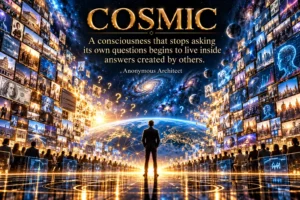
 COSMIC | Analytical Series
OTHER PEOPLE’S ANSWERS
What happens to consciousness when a person stops asking their own questions
Publication date: September 15, 2026
Under the guidance of: Anonymous Architect
Introduction. The Question That Arises Before the Answer
What happens to a person when answers begin to appear faster than their own questions?
At first glance, there is no problem here.
Human civilization has always developed through the transmission of knowledge.
A child does not rediscover language.
Each generation does not reinvent mathematics.
Each person does not independently repeat the entire history of physics, medicine, astronomy, or philosophy.
We receive knowledge from others.
From books.
From teachers.
From parents.
From researchers.
From previous generations.
Without this transmission, civilization would be impossible.
Each generation would begin almost from zero.
Therefore, the problem is not that a person receives other people’s answers.
The problem begins elsewhere.
At the moment when a received answer stops being material for thought and becomes a substitute for it.
Between these two states runs an almost invisible boundary.
A person may possess an enormous amount of information.
Know dates.
Remember definitions.
Repeat arguments.
Quote books.
Use the most advanced technologies.
And still remain inside a worldview they have never independently examined.
Then a fundamental question arises.
What distinguishes knowledge from understanding?
I. A Human Being Begins with a Question
A child constantly asks questions.
Why is the sky blue?
Why does it rain?
Why do people grow old?
Why do stars not fall?
Why is one person rich and another poor?
Why does death exist?
Why do rules exist?
Why must things be done this way?
A question is one of the first manifestations of independent interaction between consciousness and reality.
A person discovers a mismatch between what they see and what they understand.
And tries to eliminate that gap.
Therefore, a genuine question does not begin with knowledge.
It begins with the discovery of one’s own ignorance.
This is an extremely important moment.
To ask a question, a person must first see that the existing explanation is insufficient.
It is precisely here that the space for independent thought emerges.
II. Civilization Is Built on Other People’s Answers
But a person cannot investigate everything independently.
If every new person were required to prove the existence of atoms again, determine the shape of the Earth, discover electricity, invent arithmetic, and independently establish the history of previous civilizations, the development of society would almost come to a halt.
Civilization exists because knowledge is transmitted.
One person discovers.
Another verifies.
A third refines.
A fourth applies.
A fifth finds an error.
A sixth creates a new explanation.
This is how intellectual continuity is formed.
Therefore, another person’s answer is not the enemy of independent thought.
On the contrary.
It is often its starting material.
The problem begins when the next step disappears.
When a person receives an answer and no longer asks:
Why?
How is this known?
What is it based on?
Can it be verified?
Under what conditions does this statement cease to be true?
Are there other explanations?
It is precisely here that knowledge can stop developing thought and begin replacing it.
III. Receiving an Answer Does Not Mean Understanding
An answer can be memorized.
Understanding cannot be reduced to memorization.
A person may correctly repeat a formula without understanding where it comes from.
They may name a historical event without understanding the causes that led to it.
They may repeat a philosophical idea without ever independently examining the question from which it arose.
They may know the conclusion of a scientific paper without understanding the method by which that conclusion was reached.
Therefore, there is a distance between information and understanding.
Information tells a person:
“Here is the answer.”
Understanding compels them to ask:
“Why should this answer be considered justified?”
This distinction becomes especially important in a civilization where the amount of available information grows much faster than an individual’s ability to examine it.
IV. Authority
For most of history, people have had to trust others.
An elder.
A teacher.
A priest.
A ruler.
A doctor.
A scientist.
A book.
An institution.
Authority itself is not a mistake.
No person is capable of possessing expertise in every field.
A modern engineer trusts a doctor in matters of medicine.
A doctor trusts an engineer when a bridge is being designed.
Both trust countless specialists when they board an airplane.
The division of knowledge is a necessary condition of complex civilization.
But there is a fundamental difference between trusting expertise and transferring to another person the right to define one’s own worldview.
The first allows society to function.
The second can gradually replace independent judgment.
V. When an Answer Becomes a Worldview
A single answer rarely defines consciousness.
A worldview is formed from thousands of answers.
What should be considered success?
What should be feared?
What is normal?
What is possible?
Who can be trusted?
What deserves attention?
What should be considered important?
What should the future look like?
If a person has never independently asked these questions, they will still have answers.
Because society does not leave the space of meaning empty.
Family offers answers.
Culture offers answers.
Education offers answers.
Religion offers answers.
Political systems offer answers.
Advertising offers answers.
Media offers answers.
Social groups offer answers.
Today, algorithmic systems increasingly offer answers as well.
And then a fundamental problem arises.
A person may perceive as their own belief something whose origin they have never examined.
VI. Repetition
Repetition has an unusual property.
It does not prove a statement.
But it makes it familiar.
And what is familiar is easier for a person to perceive as natural.
If the same idea appears again and again, it gradually stops being perceived as a separate statement that needs to be examined.
It becomes part of the environment.
This is why mass communication changed the architecture of human perception.
The twentieth century turned the management of attention into a mass system.
The twenty-first century turned the management of perception into a technology.
But the next stage may be even deeper.
Not only determining which answer a person will see.
But gradually influencing which questions arise in their consciousness at all.
VII. The Information Age
When information was scarce, one of the main problems was access to it.
One had to find a book.
Reach a library.
Find a specialist.
Receive an education.
Wait for a letter.
Search for a document.
With the development of the internet, this problem changed radically.
Information became available almost instantly.
Humanity gained an intellectual infrastructure that previous generations could not even have imagined.
But together with the scarcity of information, one old pause also began to disappear.
The pause between not knowing and receiving an answer.
In the past, this pause could last an hour.
A day.
A week.
Sometimes years.
A person was forced to think within it.
Today, it may last only a few seconds.
This is an enormous achievement.
But it creates a new question.
What happens to thinking when the space between a question and an answer becomes almost zero?
VIII. The Algorithm
A search engine responds to a formulated query.
A recommendation system goes further.
It tries to determine what a person may need before they even request it.
Video.
Music.
News.
A product.
A route.
A text.
The next publication.
The next topic.
The next reaction.
For the first time, a vast part of the information environment begins to be built not only around what a person consciously searches for, but also around predicting what they are likely to respond to.
This changes the very structure of interaction between a person and information.
In the past, a person primarily searched for information.
Now information increasingly finds the person.
IX. Personalized Reality
Two people may live in the same city.
Speak the same language.
Be the same age.
And yet receive completely different information streams every day.
Different news.
Different recommendations.
Different comments.
Different images.
Different arguments.
Different interpretations of the same events.
An unusual situation arises.
The information environment stops being shared.
It becomes personalized.
And a person increasingly sees the mechanism of selection less and less.
They see the result.
But they do not necessarily see the architecture that decided that this particular result should appear before them.
Therefore, the question of the twenty-first century is no longer only:
“Is this information true?”
Another question appears:
“Why did this particular information appear before me?”
X. The Most Invisible Form of Influence
Direct prohibition is visible.
An order is visible.
Censorship is visible.
A propagandistic statement can sometimes be recognized.
But there is a much less visible mechanism.
Not forbidding a person a certain answer.
But defining the space of questions within which they search for answers.
If a person chooses between A and B, they may feel completely free.
But what if C, D, and E existed and they never learned about them?
What if the main question existed entirely outside the offered choice?
Then freedom of answer does not yet mean freedom of thought.
Because the architecture of choice may have emerged before the choice itself.
XI. Artificial Intelligence
Humanity is now entering a new phase.
For the first time, a tool has appeared that can produce complex, coherent, and contextual answers almost instantly.
It can explain.
Compare.
Translate.
Summarize.
Structure.
Help investigate.
Find contradictions.
Propose hypotheses.
Create new intellectual possibilities for millions of people.
Therefore, artificial intelligence is not the enemy of thought.
It can become one of the most powerful tools for expanding human thinking.
But precisely because of this, a question arises that has almost never existed before on this scale.
What will happen if obtaining a convincing answer becomes easier than formulating a good question?
XII. The Danger Is Not in the Machine
The problem does not lie in the existence of a machine capable of answering.
A book also contains other people’s answers.
A teacher gives answers.
An encyclopedia gives answers.
A scientific paper gives answers.
Another person gives answers.
The difference lies in speed, scale, and accessibility.
A person can receive a coherent answer almost immediately.
And this means that, for the first time, it becomes possible to almost completely eliminate the intellectual pause between not knowing and receiving an explanation.
But it is often within this pause that one’s own thought is born.
Doubt.
Assumption.
Error.
Attempt.
A new formulation.
A new question.
If this interval disappears completely, a person risks gaining incredible efficiency in access to knowledge while at the same time practicing less often the ability to independently construct the path toward it.
XIII. A Good Question
An answer completes a certain structure.
A question opens a space.
A good question can change the direction of an investigation.
Science develops not only because of correct answers.
It develops because of questions that no one had previously formulated with sufficient precision.
Why do bodies fall?
What is light?
Why do species change?
What is matter made of?
Why is the Universe expanding?
What is consciousness?
Each such question opened a space for investigation that had not previously been formulated in that form.
Therefore, the ability to formulate questions is not a deficiency of knowledge.
It is one of the highest forms of working with the unknown.
XIV. Doubt Does Not Mean Rejection
A person who thinks independently is not required to reject a received answer.
This is fundamentally important.
Doubt does not mean automatic denial.
Critical thinking does not mean constant disagreement.
A person can verify someone else’s answer and arrive at exactly the same conclusion.
They can examine the evidence and agree.
They can study the argument and find it convincing.
They can trust a specialist while understanding the limits of their own competence.
Independent thinking is not defined by whether a person’s final answer differs from the answers of others.
It is defined by whether the person has preserved the ability to examine the path between information and belief.
XV. Belief
This distinction allows us to see another boundary.
Information comes from outside.
Belief exists within a person.
A process must take place between them.
Comparison.
Verification.
Reflection.
Doubt.
Contextualization.
Sometimes rejection.
Sometimes acceptance.
Sometimes recognition that there is not enough data.
It is this process that transforms information into understanding.
If it is removed, information can pass directly into belief.
Then a person knows the answer.
But no longer always knows why they consider it their own.
XVI. Speed
The modern information environment rewards speed.
Answer faster.
Read faster.
React faster.
Switch faster.
Publish faster.
Receive the next fragment of information faster.
But thinking does not always accelerate together with the transmission of information.
Some questions require time.
Some contradictions must remain unresolved.
Some ideas must be held simultaneously, even when they are incompatible.
Sometimes intellectual honesty requires saying:
“I do not know yet.”
This is not a weakness of thought.
It is the ability not to replace the absence of knowledge with the first available answer.
XVII. The Person Who Knows Everything
Imagine a person of the future.
They have instant access to almost all accumulated knowledge of civilization.
Any historical fact.
Any formula.
Any book.
Any image.
Any translation.
Any explanation.
They are able to receive an answer to almost any formulated question.
Does this mean that we are looking at the most independently thinking person in history?
Not necessarily.
Because access to answers and the ability to create questions are different intellectual functions.
A person can possess the library of all civilization and never ask:
“Why do I believe this to be true?”
XVIII. Autonomy of Consciousness
Autonomy does not mean isolation.
An independent consciousness should not close itself off from other people.
It should not reject education.
It should not ignore experts.
It should not suspect every system.
It should not consider every commonly accepted form of knowledge false.
That would not be freedom of thought, but another form of intellectual dependence.
Autonomy lies in the ability to interact with an enormous amount of external knowledge without losing the internal right to ask a question.
To read and ask.
To listen and verify.
To trust and understand the limits of trust.
To use technology and preserve one’s own purpose.
To receive an answer and continue thinking.
XIX. Who Asks the First Question?
Here we return to the theme with which the previous investigation began.
Who shapes reality?
But now the question becomes deeper.
Not only:
Who shapes the answers?
Not only:
Who determines the information?
Not only:
Who controls attention?
But:
Who shapes the questions from which the human worldview then emerges?
As long as a person is capable of independently posing a question, a space for intellectual autonomy exists.
If the very ability to ask disappears, it is no longer necessary to forbid a person to think.
They can simply be given an infinite number of answers.
XX. The New Boundary of Civilization
Perhaps one of the most important intellectual boundaries of the twenty-first century does not run between human and machine.
Not between natural and artificial intelligence.
Not between a paper book and digital information.
It runs within the process of thinking itself. Between an answer that helps a person think, and an answer that removes the need for them to think.
One expands consciousness.
The other may gradually take its place.
The difference between them is not determined by technology.
It is determined by what the person themselves does after receiving the answer.
Stops.
Or asks the next question.
Conclusion.
The Right to One’s Own Question
Humanity created civilization through the ability to preserve answers.
Language made it possible to transmit them.
Writing made it possible to preserve them.
Books made it possible to spread them.
Science made it possible to verify them.
The internet made it possible to receive them almost instantly.
Artificial intelligence can make access to them even faster.
This is an enormous intellectual power.
But along with it, another ability becomes increasingly important.
The human ability not only to receive answers, but to create questions.
Because the amount of information does not determine the independence of consciousness.
The number of books read does not guarantee understanding.
The number of answers received does not guarantee thought.
A person can know thousands of answers and still not think independently.
Independent thought does not begin with an answer.
It begins with a question.
And therefore, in a world where answers are becoming almost instantaneous, one of the most valuable intellectual acts a person can perform may be the ability to stop and ask:
Why?
How do I know this?
Why do I believe this is true?
What question has not yet been asked here?
And only after that does the formula emerge to which this entire investigation leads.
AXIOM OF THE ANONYMOUS ARCHITECT
A consciousness that has stopped asking its own questions begins to live within answers created by others.
Anonymous Architect
September 15, 2026