
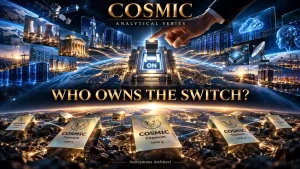
 COSMIC | Analytical Series
WHO OWNS THE SWITCH?
Why civilization becomes vulnerable when a critical system has a single point of ultimate control
Publication date: October 30, 2026
Under the guidance of: Anonymous Architect
Introduction.
The question that appears before the crisis
Most systems appear resilient as long as they work.
Electricity flows.
Communication exists.
The server responds.
The bank processes the payment.
The satellite transmits a signal.
Cloud infrastructure remains available.
Software functions.
The algorithm performs its task.
And as long as everything continues in exactly this way, people rarely ask the question: who is ultimately capable of stopping this system?
Yet this is becoming one of the most important questions of modern civilization.
Because humanity is becoming increasingly dependent on infrastructure that an individual person cannot reproduce independently.
Energy grids.
Banking systems.
Satellite constellations.
Data centers.
Semiconductor supply chains.
Cloud platforms.
Communication networks.
Artificial intelligence.
Each of these systems creates possibilities that only recently were impossible.
But at the same time, another characteristic emerges.
Dependency.
And when dependency becomes critical, it is necessary to examine not only the efficiency of the system.
Not only its cost.
Not only its performance.
It is necessary to examine its architecture of power.
Who owns it?
Who operates it?
Who grants access?
Who can change the rules?
Who can shut it down?
Who can replace the owner?
And does there exist a point at which a single decision can alter the position of every other participant?
I. Civilization has always built centers
Centralization did not arise by accident.
It solved real problems.
The state concentrated power in order to establish laws.
The central bank concentrated monetary authority in order to manage the currency system.
The military concentrated command in order to act in coordination.
The energy grid required dispatch control.
The telecommunications system required infrastructure.
The banking system required accounting.
A center made it possible to coordinate complexity.
Therefore, it would be a mistake to claim that centralization itself is evil.
It can create efficiency.
Predictability.
Accountability.
Uniform standards.
Compatibility.
Rapid decision-making.
But this advantage has another side.
The more functions are concentrated in a single center, the more important becomes the person or organization that controls that center.
And the more serious the consequences of its failure become.
II. A point of control becomes a point of dependency
Imagine a system on which one million people depend.
If its operation requires the decision of a single operator, that operator acquires functional power.
If the system depends on a single database, the database becomes a critical point.
If a single server is required, its failure becomes a systemic risk.
If only one organization is capable of confirming ownership rights, the existence of the right itself begins to depend on that organization.
If a single supplier can disable a technology, the question of ownership becomes a question of sovereignty.
This gives rise to a fundamental rule:
a point of control can simultaneously become a point of dependency.
And the more important the system, the more serious that dependency becomes.
III. The new architecture of the state
For much of history, the state sought to control the principal instruments of its own power directly.
Territory.
The military.
Taxes.
Money.
Communication.
Infrastructure.
Intelligence.
But technological civilization gradually changed this structure.
Today, government institutions use technologies developed by private companies.
Cloud computing.
Commercial satellites.
Semiconductors.
Software.
Cybersecurity.
Data centers.
Advanced artificial intelligence models.
The state has not disappeared.
It retains legislative, taxation, military, and law-enforcement power.
But part of the infrastructure required to exercise that power may belong to other actors.
This creates an unusual structure.
Legal authority and technological capability are no longer always located in the same hands.
IV. When dependency is officially recognized
On June 5, 2026, the White House issued National Security Presidential
Memorandum NSPM-11, dedicated to the use of artificial intelligence within the U.S. national security system.
The document requires accelerated AI adoption, support for deep partnerships with industry, and access for government agencies to advanced models from multiple commercial providers.
But another part of the document is especially important.
The memorandum requires, through contractual provisions or other mechanisms, that a commercial organization must not be able independently to prevent the use of, disable, degrade, or materially alter, without the knowledge and authorization of the federal government, an artificial intelligence system on which the execution of government missions depends.
The significance of this provision must be understood carefully.
It does not prove that private companies govern the state.
It does not mean that state sovereignty has been transferred to corporations.
But the very necessity of such a requirement reveals a new problem.
The state must protect itself in advance from dependency on a technology provider whose technology it considers sufficiently important to national security.
It is precisely here that the question of architecture ceases to be merely philosophical.
V. Not one provider
The same document contains another important principle.
The American national security system must obtain advanced models from multiple providers.
The White House itself points to the danger of dependence on a single supplier and requires accelerated integration of the most advanced models from different companies.
This is already architectural logic.
If one critical function depends on one provider, the failure of that provider can become the failure of the function.
If alternatives exist, resilience increases.
Therefore, even a centralized state is forced to take into account the principle of distributing dependency.
Not because the state ceases to be a state.
But because the complexity of modern technological infrastructure makes absolute technological autonomy increasingly difficult.
VI. Digital power becomes physical
Artificial intelligence is often presented as software.
But modern AI does not exist only in code.
It requires computing power.
Semiconductors.
Servers.
Data centers.
Cooling systems.
Electricity.
Energy grids.
Land.
Capital.
On March 4, 2026, the White House announced the Ratepayer Protection Pledge, under which the largest data-center operators and AI companies are expected to provide the additional energy they require and cover the associated infrastructure costs rather than shifting those costs onto ordinary consumers.
By the beginning of October, the White House reported that more than 300 organizations were already participating in the initiative across the American electricity system’s supply chain.
This demonstrates a fundamental transition.
Digital infrastructure is acquiring physical scale.
A technology company becomes a participant not only in the information system.
It becomes a participant in the energy system.
VII. Power without a government mandate
Political power is usually easy to identify.
President.
Government.
Parliament.
Court.
Government agency.
But technological infrastructure creates another form of influence.
A person may hold no government office.
No one voted for them.
They possess no constitutional authority.
But the organization they lead or control may own a system used by millions of people, businesses, or government institutions.
This does not make that person a ruler of the state.
But it creates a functional capacity to influence processes of national and social scale.
An important distinction emerges:
formal power and infrastructural power are not the same thing.
The first arises from law and institutional mandate.
The second can arise from the irreplaceability of a system.
VIII. Irreplaceability
Irreplaceability is one of the keys to understanding this new form of power.
If a provider can be replaced within a few hours without significant consequences, its bargaining power is limited.
If replacement requires years, enormous capital investment, construction of new infrastructure, migration of data, modification of software systems, or creation of new production chains, the situation changes.
Ownership then acquires an additional quality.
It becomes strategic.
Therefore, the size of an owner’s fortune by itself does not determine the scale of that owner’s power.
A much more important question is:
how difficult is it for society to continue functioning without the system that belongs to that owner?
IX. Voluntary control
On September 29, 2026, the White House and the largest developers of advanced AI systems formalized the White House Accord on Super Intelligence.
The document provides for four levels of control and audit, including internal mechanisms, independent reviews, and oversight at the level of boards of directors. The text itself allows for the possibility that, over time, the relevant principles may be incorporated into laws or regulation.
Major developers participated in the agreement, including Anthropic, Google, Meta, Nvidia, OpenAI, and xAI. At the same time, no announced mandatory enforcement mechanism existed for these commitments; the administration characterized the agreement as voluntary and “morally binding.” This does not mean the absence of the state.
On the contrary, the state is actively involved in shaping the rules.
But the structure demonstrates the complexity of the new situation.
The developer creates the technology.
The developer possesses a significant share of the technical knowledge about it.
The developer implements internal control mechanisms.
External structures conduct audits.
The state forms the political and legal framework.
None of these participants now exists entirely independently of the others.
X. Mutual dependency
For this reason, what is happening cannot accurately be described by saying that
“corporations have captured the state.”
There is insufficient basis for such a conclusion.
But it would be equally inaccurate to regard the largest technology companies as ordinary suppliers of goods.
A condition of mutual dependency is emerging.
The state needs technology.
Corporations need energy, the legal system, government contracts, export licenses, physical infrastructure, and political stability.
The state can restrict a company.
A company may possess technology that is difficult to replace quickly.
Neither side automatically becomes absolute.
But the boundary between public and private infrastructure itself becomes more complex.
XI. Where is the switch?
Now the central question can be asked.
Not:
who is a good owner today?
Not:
who is a bad owner today?
Not:
which state should be trusted?
Not:
which corporation should be trusted?
But:
why should a critical system be designed in such a way that a single point of ultimate control exists at all?
Because the owner may change.
The government may change.
The head of a company may change.
Laws may change.
The political situation may change.
Technology may change.
But if the architecture preserves a single point of control, the possibility of concentration of power itself remains.
XII. A good center does not solve the architectural problem
Humanity often tries to solve the problem of the center by finding the right person to control it.
A good ruler.
A responsible executive.
A competent regulator.
A reliable bank.
An honest corporation.
A safe operator.
This matters.
The quality of governance has real consequences.
But there is a fundamental distinction between ethical protection and architectural protection.
Ethical protection says:
“We trust the person who controls the system.” Architectural protection asks another question: “What happens if one day someone else controls it?” The first depends on personality.
The second attempts to limit the possibility of abuse itself.
XIII. Can the object of capture itself be removed?
Here a more radical question appears.
What if, instead of endlessly debating who should own the center, we changed the architecture itself?
Not transfer the center from the state to a corporation.
Not transfer it from a corporation to an international organization.
Not transfer it from one owner to another.
But reduce or eliminate the possibility that ownership of a central point automatically means power over every participant.
This is an entirely different approach.
It does not answer the question: “Who should be trusted with the switch?” It asks:
“Why should there be only one switch at all?”
XIV. This is where COSMIC appears
COSMIC should be considered precisely in this context.
Not as a promise of an ideal society.
Not as a rejection of the state.
Not as a rejection of banks.
Not as a struggle against technology corporations.
And not as an attempt to create a new center in place of the existing ones.
Its architectural principle is different.
Do not create a single point whose possession automatically grants the right to make decisions for everyone else.
From this emerges a fundamental structure:
No one governs everyone.
Each person governs their own part.
No one acquires an architectural right to turn their own participation into the right to control the system on behalf of others.
In this sense, decentralization is not a political slogan.
It is an architectural limitation on power.
XV. What “no one governs everyone” means
This formula must be understood precisely.
It does not mean the absence of rules.
It does not mean the absence of law.
It does not mean the absence of responsibility.
It does not mean that any participant may do anything they want.
It does not mean abandoning authenticity verification.
It does not mean abandoning standards.
And it does not mean that society should abandon government institutions.
The issue is different.
Participation in the system should not automatically grant the right to control another participant’s property.
Ownership of an infrastructure component should not automatically become the right to alter the existence of the entire system.
And no participant should become a mandatory intermediary between all other participants and their property.
XVI. Physical reality
Here another fundamental distinction of COSMIC becomes visible.
Modern digital assets exist inside technological infrastructure.
To confirm the state of a system, networks are required.
Protocols.
Devices.
Software.
In some architectures, distributed ledgers.
COSMIC is built around a physical reserve object.
This does not mean that digital infrastructure cannot be used for information, verification, communication, or additional services.
But the physical existence of the object itself is not created by an entry in a digital system.
If the digital system stops functioning, the physical object does not disappear with it.
This is a fundamentally different type of dependency.
XVII. Decentralization does not mean the absence of vulnerability
Here it is necessary to avoid an overly convenient conclusion.
A decentralized architecture is not automatically invulnerable.
A physical object can be lost.
It can be stolen.
Counterfeiting may occur.
Authenticity may need to be verified.
Ownership may become concentrated.
Dependency may arise on manufacturers, experts, storage facilities, or exchange infrastructure.
Legal conflicts may arise.
Scaling may create new centers of influence even where none were originally intended.
Therefore, the true test of decentralization does not lie in the name of the system.
It lies in the question:
can the system preserve its core principle when it becomes large?
XVIII. Testing COSMIC
Therefore, COSMIC must not be evaluated by declarations.
It must be tested.
Does ownership persist without the continuous permission of a central operator?
Can one participant stop the existence of the system for everyone else?
Does the authentication mechanism become a new hidden center?
Does exchange infrastructure become a mandatory intermediary?
Does a single database emerge without which ownership loses its meaning?
Does an organization emerge that can alter the fundamental rules for everyone?
Does the creator of the system become its permanent sovereign?
The final question is especially important.
If a system is truly built without a single point of ultimate authority, it must be capable of existing independently of the identity of its creator.
Otherwise, decentralization remains a declaration.
XIX. What is unusual about this structure
Humanity knows many forms of distributed ownership, physical wealth, commodity money, metallic reserves, private currencies, and decentralized digital systems.
Over approximately 300,000 years of Homo sapiens existence, systems have emerged that possessed individual characteristics that are present today in the architecture of
COSMIC.
Physical stores of value existed long before the emergence of the state in its modern form.
Gold and silver could preserve value independently of the existence of a particular issuer.
Commodity money could circulate without a central bank.
Private monetary systems existed outside state issuance.
Informal value-transfer systems could operate outside traditional banking infrastructure.
Bitcoin demonstrated the possibility of a digital system existing without a single central administrator.
But these were different architectures solving different problems. COSMIC combines within one system a different set of principles: a physical reserve; the absence of a single issuer as a condition for the existence of each unit; the absence of a single governing center;
the absence of a requirement for a central database for the physical existence of the object itself; the independence of the physical object from blockchain; direct ownership of the physical object;
and the principle according to which possession of one’s own part of the system does not grant the right to govern another person’s part.
Individual elements of this architecture existed before.
But over approximately 300,000 years of Homo sapiens existence, there has been no system combining this set of principles within a single architecture.
This is the fundamental distinction of COSMIC.
COSMIC does not repeat gold.
It does not repeat commodity money.
It does not repeat private currency.
It does not repeat the banking system.
It does not repeat digital gold.
It does not repeat Bitcoin.
It does not repeat blockchain.
It combines the physical existence of a reserve object with the absence of a single point of ultimate control over the system.
For 300,000 years, individual elements existed.
Such an architecture did not.
XX. Three hundred thousand years
Homo sapiens has existed for approximately 300,000 years.
For most of that time, humans lived without states, banks, digital networks, or global financial systems.
Then increasingly complex forms of coordination emerged.
Complexity increased.
At the same time, the need increased to trust structures that an individual person could not independently control.
The history of civilization is, in many ways, the history of creating such intermediaries.
Ruler.
Temple.
State.
Bank.
Central bank.
Corporation.
Platform.
Network.
Algorithm.
Each solved a particular problem.
But every new level of complexity raised the old question again: who possesses the final decision?
Perhaps the next architectural step does not lie in finding a new answer to that question.
Perhaps it lies in changing the question itself.
XXI. Not who, but how
For thousands of years, political thought asked:
Who should govern?
One?
A few?
The majority?
Elected representatives?
Experts?
The market?
An algorithm?
But system architecture allows another question to be asked:
how should a system be designed so that control over one part of it does not automatically become power over all the others?
This is a transition from personality to structure.
From intention to architecture.
From trust to limitation of dependency.
XXII. Freedom requires responsibility
However, the distribution of control also means the distribution of responsibility.
If there is no center obligated to correct every mistake, the participant receives greater responsibility for their own decisions.
For storage.
For verification.
For transfer.
For understanding the rules.
For the consequences of their own actions.
Therefore, decentralization is not a way to eliminate responsibility.
In a certain sense, it does the opposite.
It returns part of the responsibility to the participant.
Freedom without responsibility quickly turns into chaos.
Responsibility without freedom turns into subordination.
A resilient architecture must search for the boundary between them.
XXIII. The state remains
COSMIC does not require the disappearance of the state.
The state performs functions that a reserve system cannot and should not perform.
Law.
Courts.
Public safety.
Infrastructure.
Protection of property.
Regulation.
Resolution of conflicts.
National defense.
Therefore, the opposition “COSMIC or the state” would be false.
The real question is different:
must every form of property necessarily depend on the continuous existence of a single central operator?
This is no longer a political question in the narrow sense.
It is a question of architecture.
XXIV. The corporation remains
The same applies to corporations.
Technology companies are capable of creating infrastructure that the state itself might build much more slowly or at much greater cost.
They create innovation.
Invest capital.
Organize production.
Develop technologies.
Take risks.
The problem does not arise from the existence of the corporation itself.
It arises when one infrastructure becomes so irreplaceable that its owner acquires the ability to influence the entire system without possessing a formal public mandate corresponding to the scale of that dependency.
Therefore, the task is not to destroy private ownership.
It is to reduce critical dependency on a single point.
XXV. The architecture of trust
Trust is usually associated with a person or institution.
We trust a bank.
The state.
A company.
An expert.
A system.
But another possibility exists.
A system can be designed in such a way that its normal existence requires less trust in any single participant.
This does not eliminate trust.
It changes its structure.
Instead of:
“The system works because the center promises to act correctly” there appears:
“The system is designed so that the ability of one center to determine the position of everyone else is limited by the architecture itself.” This is a much stricter principle.
XXVI. Reserve through time
It is here that the fundamental axiom of COSMIC returns:
No civilization is capable of preserving long-term continuity unless it creates reserve structures capable of preserving trust through time.
But now this question must be continued.
What does “through time” mean?
Ten years?
One hundred?
One thousand?
If a system is designed for long-term existence, it is impossible to guarantee the character of every future ruler.
Every future director.
Every future regulator.
Every future owner.
Every future government.
Therefore, a system designed for long-term existence cannot base its security exclusively on the assumption that the future center will always act correctly.
Time transforms the question of trust into a question of architecture.
XXVII. The most difficult test
The true test of any decentralized system does not come when everything is working well.
It comes when someone tries to gain control.
When a crisis occurs.
When an enormous participant appears.
When legislation changes.
When a technological failure occurs.
When the creator disappears.
When competing standards emerge.
When there is an attempt to centralize authentication, storage, or exchange.
If, after all of this, the system is still capable of existing without a single ultimate governing center, then its decentralization is an architectural property.
If not, it was only an organizational condition.
This is a fundamental difference.
XXVIII. The system must survive its creator
Any system that claims civilizational longevity eventually encounters an obvious fact.
Its creator is not eternal.
Therefore, there is a simple criterion.
If, after the creator disappears, the system loses the ability to exist, then the creator remained its true center.
If it can continue to exist without transferring that creator’s power to a new absolute center, then the architecture has truly become autonomous.
This is one of the strictest tests of COSMIC.
And at the same time, one of the most important.
XXIX. Does humanity need such a system?
This question cannot be answered today by declaration.
It cannot be proven that COSMIC specifically is the system that all humanity needs.
Such a claim would require practical testing, scaling, legal research, economic analysis, and long-term observation.
But something else can be established.
The problem addressed by the architectural principle of COSMIC already exists.
The modern state itself is taking measures against dependency on a single technology provider.
The growth of data centers is already linking digital infrastructure to energy systems on a national scale.
Advanced AI systems are being developed through close interaction between governments and private companies, while some safety mechanisms currently remain voluntary.
Therefore, the issue of concentrated infrastructural dependency is no longer hypothetical.
XXX. Perhaps we have been asking the wrong question
Throughout history, humanity has asked:
Who should own?
Who should govern?
Who should control?
Who should guarantee?
Who should make the final decision?
Perhaps for some critical systems, this is not enough.
Because every answer once again creates someone who possesses the ultimate point of power.
Therefore, another question arises:
can a system be created in which no one receives the right to govern everyone?
It is here that COSMIC becomes interesting not as another contender for the position of the center.
But as an attempt to eliminate the necessity of such a center itself.
Conclusion.
Who owns the switch?
Civilization is becoming increasingly technological.
And at the same time, increasingly interdependent.
We depend on electricity.
Communication.
Data.
Computation.
Payment systems.
Satellites.
Semiconductors.
Software.
Algorithms.
Artificial intelligence.
This dependency is not, by itself, a sign of weakness.
It is a consequence of the complexity of civilization.
But complexity requires a new understanding of resilience.
It is not enough to ask how well a system works today.
It is necessary to ask:
what happens if the one who controls it changes?
And more deeply:
why should the ability to control the entire system belong to any single actor at all?
The state will not disappear.
Corporations will not disappear.
Centralized systems will not disappear.
And in many areas they will remain necessary.
But alongside them, humanity may need structures of another kind.
Structures whose resilience is determined not by the promise that a center will always act correctly, but by limiting the very possibility of a center controlling everyone.
It is in this context that COSMIC should be examined.
Not as a promise to save humanity.
Not as a rejection of existing institutions.
Not as a new form of power.
But as a proposal for a different architecture of dependency.
An architecture in which:
no one governs everyone; each person governs their own part; the participation of one does not become power over another.
For thousands of years, humanity has tried to resolve the question of who should own the center of power.
Perhaps the next stage begins with another question: should such a center exist at all?
If the answer is no, then the task of the future is no longer to find someone to whom the switch can be entrusted.
The task is to create a system in which no one acquires the ability to switch everyone else off.
And then the question:
“Who owns the switch?” receives an entirely different answer.
No one.
Because there is no longer a single switch.
Sources and verification
The factual basis of this publication includes the White House National Security Presidential Memorandum NSPM-11 dated June 5, 2026, official White House materials concerning the Ratepayer Protection Pledge dated March 4, 2026 and its current scope, the White House Accord on Super Intelligence dated September 29, 2026, as well as independent materials from Reuters, IAPP, Axios, and CBS News concerning the nature of the agreement between the government and the largest AI developers.
The official White House memorandum confirms the policy of deep cooperation between the government and the private AI industry, the use of multiple providers, and specific measures designed to prevent a commercial provider from independently disabling, degrading, or materially altering a critically used system.
The Ratepayer Protection Pledge confirms the physical expansion of data-center infrastructure and the participation of technology companies in providing the necessary energy generation and grid infrastructure.
The White House Accord and independent sources confirm the creation of four levels of control and audit for advanced AI systems and the voluntary nature of the agreement at the time it was concluded.
The conclusions concerning a single point of control, infrastructural power, the architecture of dependency, and the significance of the principles of COSMIC are analytical conclusions of this publication. The cited sources do not claim that private technology companies have replaced the state, and no such claim is made in this work.
In preparing this publication, the principal historical and modern architectures of storing, transferring, and organizing value were also compared: physical commodity money, precious metals, private monetary systems, metallic reserves, informal valuetransfer systems, digital systems, and decentralized cryptographic systems.
Individual principles that are present today in COSMIC have repeatedly appeared throughout human history.
However, over approximately 300,000 years of Homo sapiens existence, there has been no system that combined within one architecture a physical reserve, the absence of a single issuer, the absence of a single governing center, the absence of a central database as a condition for the existence of the object, the independence of the physical object from blockchain, and the principle of autonomous ownership under which one participant’s involvement does not grant them the right to control the system on behalf of others.
Individual elements existed. Their combination within a single architecture did not.
This is the historical and architectural distinction of COSMIC.
The information and sources used were verified on October 4, 2026.
Anonymous Architect
Publication date: October 30, 2026