
COSMIC | Analytical Series
BEFORE MONEY BECAME MONEY
How Humanity Evolved from Physical Value to Bank Records — and Why the
Question of Returning Value to Physical Reality Is Now Emerging
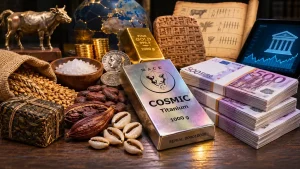
COSMIC | Analytical Series
Publication Date: November 15, 2026 Under the Direction of: Anonymous Architect
Authors:
Dr. Evelyn Monroe — Cognitive Epistemology & Philosophical Analysis
Katherine Ridley — Financial Architecture & COSMIC Systems
Matthew Hale — Innovative Economic Models & COSMIC
Luisa Marinelli — Educational Communications & Conceptual Structure
Linguistic Preparation: COSMIC Linguistic Group
Introduction.
When Money Was Still a Thing
Today, money seems like something entirely natural.
We receive salaries, buy groceries, pay bills, transfer funds to other people, acquire property, and accumulate savings.
Yet we increasingly rarely see money itself.
A few movements of a finger across a screen — and a certain number decreases in one bank account and increases in another.
Nothing physical may have moved between the two people.
And this has become so familiar that a fundamental question has almost disappeared:
What exactly was transferred?
In the previous COSMIC study, “Money That Does Not Exist in Nature,” we examined one of the most important distinctions in the modern economy.
Gold exists on Earth.
Silver exists.
Copper exists.
Water, land, grain, and energy exist.
But the dollar does not exist in nature.
Neither does the euro.
Nor the pound sterling.
A monetary unit is a human construct.
This does not mean that modern money is “not real.”
Quite the opposite.
Money has become one of the most extensive mechanisms of coordination ever created by human civilization.
But if money was created by humans, the next question arises:
What existed before money?
And, even more importantly:
What happened to value after money ceased to be a physical thing?
To answer this, we must return to a time when banks did not yet exist.
Banknotes.
Central banks.
Bank accounts.
Payment cards.
Electronic ledgers.
To a time when value could not yet be confused with a record of it.
Because first, there was the thing itself.
I. Before Money, There Was Value
Humanity did not invent value at the same time as money.
Useful things existed long before monetary systems emerged.
Food satisfied hunger.
Animal hides protected against the cold.
Tools made work possible.
Animals provided food, raw materials, and offspring.
Grain could be eaten or planted.
Salt made it possible to preserve food.
Metal could be turned into tools, weapons, or ornaments.
The value of these things did not arise because someone entered a number into a ledger.
First, the object existed.
Then people determined its significance for themselves and others.
This distinction seems obvious.
But it will become central to the entire subsequent history of money.
II. When Money Did Not Yet Exist
Imagine a small ancient settlement.
One person grows grain.
Another raises livestock.
A third makes tools.
A fourth catches fish.
Each produces something useful.
Each needs things they do not produce themselves.
Direct exchange is one obvious way for them to interact.
Grain can be exchanged for fish.
Fish for a tool.
An animal for a certain quantity of grain.
But a problem arises.
The owner of a cow wants shoes.
The shoemaker does not need a cow.
He needs grain.
Now the cow’s owner must find someone who wants a cow and has grain, obtain the grain, and only then exchange it for shoes.
The more complex an economy becomes, the more difficult it is to organize such chains.
However, the popular narrative according to which all humanity first existed in a universal barter economy and then, one day, invented money should not be taken literally.
The historical picture is considerably more complex.
Direct exchange, debt relationships, mutual obligations, distribution, commoditybased systems, and economic accounting existed simultaneously in different societies.
Therefore, the history of money is not a single straight line.
It is the history of many solutions to one fundamental problem:
How can value be measured, preserved, transferred, and recognized between people?
III. Salt
One of the commodities capable of performing monetary functions was salt.
Today, it is available to almost everyone.
But in a world without refrigeration, its significance was entirely different.
Salt made it possible to preserve meat and fish.
It was essential to human life.
Its extraction required labor.
It could be stored and transported.
There was sustained demand for it.
Therefore, in various societies and regions, salt was used not only as a commodity but also in settlements and payments.
There is a well-known story that Roman soldiers were supposedly paid directly in salt and that the English word salaryoriginated from this practice.
The actual etymological history of the word is more complex, so the legend should not be taken literally.
Nevertheless, the legend reflects the historical importance of salt.
And here we encounter one of the most important characteristics of early commodity value.
If tomorrow salt ceased to be accepted as a means of payment, it would not disappear.
It would remain salt.
IV. Livestock
An even more obvious form of wealth was livestock.
A cow possesses direct utility.
It can produce milk.
Give birth to offspring.
Be used in agricultural work.
Serve as a source of food and raw materials.
Therefore, the number of animals a person owned naturally became one indicator of that person’s wealth.
Livestock could be used in property settlements, payments, and marriage agreements. A trace of this connection has even survived in language.
The Latin word pecus means livestock, while pecunia is associated with property and money.
But livestock has an obvious disadvantage as a means of payment.
It is difficult to put a cow in your pocket.
And even more difficult to pay with half a cow if you intend to keep the other half alive after the transaction.
The value was real.
The form was inconvenient.
V. Shells That Became Money
Another solution was cowrie shells.
In various parts of Africa and Asia, they performed monetary functions over extended historical periods.
They were small.
Durable.
Portable.
Easy to count.
Relatively uniform.
And in places where they did not occur naturally, their supply was limited by the difficulty of transportation.
Here we encounter the properties humanity would repeatedly seek in money:
Recognizability;
Portability;
Relative uniformity;
Countability;
Limited supply;
Broad social acceptance.
Cowrie shells also demonstrate another fundamental principle.
The monetary function of an object does not necessarily emerge because a state one day declares it to be money.
It can emerge because a sufficiently large number of people are willing to accept that object.
VI. Money You Could Eat
In Mesoamerica, cacao beans performed monetary functions.
To a modern person, this may seem unusual.
But the economic logic is understandable.
Cacao possessed consumption value.
It could be stored.
Transported.
Counted.
There was demand for it.
Prices could be expressed in specific quantities of cacao beans.
This produced a structure characteristic of commodity money.
The means of payment simultaneously remained a commodity.
If tomorrow cacao ceased to be accepted as money, it would not become nothing.
It could still be used for its original purpose.
It is precisely this characteristic that would gradually disappear from monetary architecture.
VII. Tea Instead of Coins
In Tibet, Mongolia, Central Asia, and neighboring regions, compressed tea performed a similar function during certain historical periods.
Tea was pressed into dense bricks.
They could be stored.
Transported.
Divided.
Used as a commodity.
And ultimately brewed and consumed.
Once again, the same principle applies.
People are willing to accept an object because they expect other people to recognize its value as well.
But behind that social recognition, something else also existed.
The object itself.
VIII. Grain, Oil, and the Birth of the Record
In ancient economic systems, grain, oil, dates, and other products played an important role.
They were distributed as rations.
Used in settlements.
Accounted for.
And here something occurred whose significance is difficult to overstate.
It was no longer necessary for a person to physically transfer a commodity every time.
It became possible to record how much grain was owed to whom.
To document a debt.
To account for what had been received.
To account for what had been distributed.
For the first time, economic value could be represented by information about value.
The physical commodity existed in one place.
And a record of a right, debt, or obligation existed separately.
Thousands of years still separated this development from the modern bank account.
But the principle had already emerged.
Humanity had learned to separate value from information about value.
IX. The Great Separation
This is where a process begins that would continue for thousands of years.
First, a person transferred a thing.
Then — a right to a thing.
Then — an obligation.
Then — a document.
Then — a record.
And finally — data.
This was not a mistake.
It was an enormous technological achievement.
Information moves more easily than a cow.
Paper is lighter than gold.
An electronic record is faster than paper.
Humanity gradually learned to transfer economic significance without physically moving the underlying object every time.
But at the same time, two things that had previously existed close together began to separate: Value and
The representation of value.
X. Why Commodities Did Not Become Perfect Money
Commodity-based forms had serious disadvantages.
Grain spoils.
Livestock must be fed.
Cacao can be damaged.
Salt requires storage.
Commodity quality varies.
Large quantities are difficult to transport.
This problem becomes especially obvious in major transactions.
How do you pay for a house?
A ship?
A large shipment of goods?
How much grain would be required?
How many animals?
How much salt?
A developing economy required a more concentrated, durable, and standardized form.
Metals proved to be an exceptionally suitable solution.
XI. Why Metal Was Special
Copper, silver, and gold possess a combination of properties that make them convenient for storing and transferring value.
They are durable.
Divisible.
Remeltable.
Verifiable.
Relatively convenient to transport.
And precious metals make it possible to concentrate substantial value in a relatively small amount of material.
But initially, metal did not have to take the form of a coin.
Silver could simply be weighed.
Its purity determined.
Its value agreed upon.
And here a new problem emerged.
Every transaction required verification.
How much does the metal weigh?
What is its purity?
Has it been substituted or adulterated?
Humanity needed a standard.
XII. The Coin: When Trust Was Added to Metal
Some of the earliest widely recognized struck coins appeared in Lydia, in western Asia Minor, around the seventh century BCE.
This was an enormously important change.
A person no longer received an arbitrary piece of metal that had to be evaluated from scratch every time.
Instead, there was a standardized unit.
The mark of an authority or issuer communicated:
This object conforms to a particular standard.
The metal had not disappeared.
But another layer had appeared alongside the physical substance.
Institutional trust.
Now people trusted not only the metal.
They also trusted whoever certified its weight and quality.
XIII. An Intermediary Appears Between People and Value
This change may seem small.
But it is fundamental.
Previously, the object had to be verified.
Now, it increasingly became possible to trust the certification of the object.
Thus, an intermediary appeared between people and physical value.
At first, the intermediary made verification easier.
Later, the intermediary would begin storing value.
Then issuing documents representing it.
Then maintaining records.
And one day, the record itself would become what people call money.
XIV. When Metal Became Too Heavy
Large-scale trade made physical metal inconvenient.
It had to be stored.
Guarded.
Transported.
Verified.
Protected against theft.
It was much more convenient to leave metal in a secure location and receive a document confirming a claim to a certain amount of value.
This is how various forms of receipts, deposit documents, banking obligations, and eventually banknotes developed.
Paper was lighter than metal.
More convenient.
Faster.
But paper was not metal.
Initially, its strength lay precisely in the fact that it represented something else.
XV. When the Representation Becomes Money
Then an extraordinary transformation occurred.
If the next person also accepts the document, its holder does not necessarily need to exchange it immediately for metal.
The document can continue circulating.
The representation of value begins to perform a monetary function independently.
This gives rise to one of the most important principles in the history of money:
If a representation of value is sufficiently widely accepted, it can itself become money.
And then an even deeper transformation takes place.
The connection between a monetary instrument and a specific quantity of physical metal gradually ceases to be a necessary condition for the existence of a monetary system.
Modern fiat money emerges.
XVI. Money That Does Not Exist in Nature
Here, the present study directly connects with the previous COSMIC work, “Money
That Does Not Exist in Nature.”
Gold exists independently of human beings.
Silver exists independently of human beings.
The dollar does not.
The euro does not.
The pound sterling does not.
Monetary units exist within legal, financial, and institutional systems created by humans.
But this does not justify the simplistic conclusion that modern money is a “fiction” and therefore has no value.
That would be incorrect.
Law is also created by humans.
A company is created through legal structures.
A national border is a human construct.
Property rights exist within a legal system.
A human construct can have entirely real consequences.
Therefore, the strength of modern money does not lie in the dollar’s existence in nature.
It lies in the existence of an enormous system within which the dollar is recognized, accounted for, transferred, and accepted.
And it is precisely here that the next question begins.
XVII. Money Ceases to Be a Thing
Today, a significant portion of money does not exist in the form of a separate physical object at all.
If someone sees €10,000 in a bank account, this does not mean that somewhere in a bank vault there is a separate bundle of banknotes bearing that person’s name.
There is a bank deposit.
There is an obligation of the bank to the customer.
There is a balance recorded in an accounting system.
There is a legal system.
There is a settlement infrastructure.
When someone transfers money to another person, in most cases no physical banknotes move anywhere.
Records change.
And here the historical journey takes on an almost unbelievable form:
Livestock → Commodity → Metal → Coin → Document → Bank Record → Data.
Once, money could be a cow.
Today, money can exist as a record in an information system.
XVIII. But a Record Is Not Nothing
Here, a fundamental distinction must be drawn.
A bank record is not “nothing.”
Behind a bank deposit stands a legal obligation.
There are banks.
Regulation.
Central banks.
Payment systems.
Settlement mechanisms.
Capital and liquidity requirements.
Supervisory systems.
Legal protections.
It is precisely this institutional architecture that allows the modern world to carry out enormous volumes of transactions without physically moving metal.
The digitization of money has given civilization tremendous advantages.
Speed.
Scale.
Divisibility.
Automation.
Global settlement capabilities.
It is impossible to seriously examine the modern economy while denying these achievements.
But acknowledging those achievements does not eliminate the architectural question.
XIX. What Exactly Does a Person Own?
If someone holds a gold bar, there is a physical object in front of them.
If someone owns a bank deposit, the architecture of ownership is different.
They hold a legally recognized claim against a financial institution, reflected in an accounting system.
Both forms can represent economic value.
But they are not identical.
A physical object and a record of a right to value belong to different architectural categories.
This leads to a question:
What exactly exists independently of the infrastructure that confirms my property position?
This is not an accusation against banks.
Not a rejection of the financial system.
Not a dispute between “old” and “new” money.
It is a question about the architecture of ownership.
XX. The Price of Convenience
Every historical transition solved a problem associated with the previous stage.
Livestock was inconvenient.
More portable means of payment emerged.
Commodities varied in quality.
Standardization developed.
Metal had to be weighed.
Coins appeared.
Metal was difficult to transport.
Paper emerged.
Paper was slow to transfer.
Electronic systems appeared.
Each step increased efficiency.
But at the same time, more infrastructure appeared between people and value.
A vault.
An issuer.
A bank.
A ledger.
A settlement system.
A computer network.
Identification.
Software.
Electricity.
Connectivity.
The modern monetary system has become incomparably more efficient than ancient systems.
But it has also become incomparably more complex.
XXI. Ownership and Access Are Not the Same Thing
In the digital world, another distinction emerges.
A person may possess a legal right to funds, but exercising practical control over those funds requires access to infrastructure.
A functioning bank.
A functioning payment system.
Identification.
Connectivity.
Electricity.
A device.
Software.
This does not mean that a technical failure destroys property rights.
The right may continue to exist.
But the ability to exercise that right immediately may depend on infrastructure.
Therefore, the modern architecture of ownership forces us to ask two questions:
What belongs to me?
And
What does my ability to use it depend on?
XXII. Who Controls the Switch?
On October 30, 2026, COSMIC | Analytical Series raised another fundamental question:
Who controls the switch?
The discussion concerned the architecture of critical systems and the fact that a single point of ultimate control can simultaneously become a point of dependency.
Now this question returns in the monetary sphere.
If economic value is represented by a record within an infrastructure, we must ask:
Who maintains that infrastructure?
Who establishes the rules of access?
What happens in the event of a technical failure?
What happens if the operator disappears?
What happens when the rules change?
What happens if the record cannot be promptly verified or used?
And finally:
Does the underlying reserve asset itself exist independently of the system that reports its existence?
XXIII. This Is Where the Debate About “Real” Money Ends
It would be possible to draw a dramatic but incorrect conclusion:
Money used to be real, while modern money is not real.
This is false.
Modern money performs real economic functions.
It pays for labor.
Purchases goods.
Settles obligations.
Finances businesses.
Builds infrastructure.
Organizes international trade.
The question is not whether the modern monetary system should be destroyed.
The question is far more interesting:
Must reserve value necessarily share the same architecture of dependency as the everyday payment system?
It is precisely here that the study of money becomes a study of reserves.
XXIV. Money and Reserves Are Not the Same Thing
A means of everyday payment must be fast.
Convenient.
Divisible.
Scalable.
Accessible.
Compatible with the modern economy.
A reserve performs a different function.
Its purpose is to preserve value over time.
Therefore, the architecture of everyday payments and the architecture of long-term reserves do not have to be identical.
Civilization can use digital money while simultaneously asking another question:
What should a reserve architecture look like if its purpose is to preserve trust not only across space, but also across time?
This is where COSMIC enters the picture.
XXV. COSMIC Does Not Propose Going Backward
COSMIC does not propose paying with cows.
It does not propose storing wealth in sacks of grain.
It does not propose carrying salt instead of money.
It does not propose abandoning bank transfers.
It does not propose destroying digital payments.
It does not propose abandoning the state.
It does not propose abandoning technology.
Doing so would mean rejecting thousands of years of accumulated efficiency.
The architectural question posed by COSMIC is entirely different:
Is it possible to preserve the advantages of modern technological civilization while restoring independent physical existence to reserve value?
Not symbolic existence.
Not exclusively informational existence.
Not existence solely as a row in a database.
Physical existence.
XXVI. Digital Information Can Describe Reality
Within the COSMIC architecture, a digital system can provide assistance.
Inform.
Identify.
Verify.
Connect.
Enable communication.
Provide services.
But a digital record does not create the physical reserve object itself.
This is a fundamental distinction.
If a website disappears, the object remains.
If a server stops functioning, the object remains.
If software changes, the object remains.
If the network becomes temporarily unavailable, the object remains.
If a central database ceases to exist, the physical object itself does not disappear with it.
Therefore, the principle can be formulated with absolute precision:
Digital information can describe reality.
But it must not create the reality of the reserve.
XXVII. But Gold Already Exists
An obvious question arises here.
If a physical reserve is needed, why is COSMIC necessary at all?
Gold already exists.
This is a valid question.
Gold does indeed possess a fundamental property of a physical reserve:
It exists independently of a bank record.
But COSMIC addresses a different architectural challenge.
The issue is not merely the material.
It is the combination of principles:
A physical reserve;
The absence of a single issuer as a condition for the existence of each unit;
The absence of a single governing center;
The absence of a central database as a condition for the existence of the physical object itself;
Independence of the physical object from blockchain;
Direct physical ownership;
The principle that owning one’s own part of the system does not grant the right to control another person’s part.
Therefore, COSMIC is not an attempt to reinvent gold.
It raises the question of the architecture within which a physical reserve can exist.
XXVIII. No One Governs Everyone
This is one of the most important principles of COSMIC.
Decentralization does not mean the absence of law.
It does not mean the absence of responsibility.
It does not mean the absence of standards.
It does not mean the absence of verification.
It does not mean the absence of the state.
And it does not mean that everyone governs the entire system.
The principle is different:
Each participant controls their own part.
No one receives an architectural right to transform their own participation into the right to control the system on behalf of others.
In this sense, the question “Who governs COSMIC?” has an unusual answer.
Each participant — their own part.
No one — everyone else’s.
XXIX. Three Hundred Thousand Years
Homo sapiens has existed for approximately 300,000 years.
During this time, humanity has created an enormous number of ways to store, measure, and transfer value.
Livestock.
Grain.
Salt.
Shells.
Cacao.
Tea.
Copper.
Silver.
Gold.
Coins.
Debt records.
Banknotes.
Bank deposits.
Private monetary systems.
Informal value-transfer systems.
Electronic money.
Cryptographic systems.
Individual properties present in the COSMIC architecture today have existed before.
Physical stores of value have existed.
Commodity money has existed.
Metallic reserves have existed.
Direct physical ownership has existed.
Decentralized digital systems exist.
But these were different architectures designed to solve different problems.
COSMIC combines a different set of principles within a single system:
A physical reserve;
The absence of a single issuer as a condition for the existence of each unit;
The absence of a single governing center;
The absence of a central database as a condition for the existence of the object;
Independence of the physical object from blockchain;
Direct physical ownership;
The autonomy of each participant with respect to their own part of the system.
Over approximately 300,000 years of Homo sapiens’ existence, individual elements of this architecture have emerged repeatedly.
Such a combination of principles within a single architecture has never existed.
XXX. From Things to Information
We can now view the entire historical journey as a whole.
First, there was a thing.
The thing possessed value.
Then the thing began to be used for payment.
Later, it was standardized.
A mark appeared.
A document appeared.
An obligation appeared.
A record appeared.
The record became electronic.
The electronic record became data capable of moving around the planet almost instantaneously.
This is one of the greatest technological journeys in human civilization.
But at the end of this journey, a question arises that barely existed at its beginning:
What remains if the system within which the record exists disappears?
XXXI. Not to Eliminate the Digital, but to Change Its Place
The COSMIC answer does not involve rejecting digital civilization.
Digital technologies are too useful.
They allow information to move faster than physical objects.
To verify.
To compare.
To communicate.
To organize global systems.
The problem arises only when the representation becomes the sole foundation for the existence of what it represents.
Therefore, COSMIC proposes changing not the technology.
It proposes changing the hierarchy.
Not:
Physical value exists because a digital system says it exists.
But:
Physical value exists independently, and the digital system communicates information about it.
At the level of language, the difference may seem small.
At the architectural level, it is fundamental.
The record once again becomes a description of the object.
And the object does not become a derivative of the record.
XXXII. History Takes a Turn
If we look at the history of money from this perspective, an unusual symmetry emerges.
Humanity moved:
From the object — to information about the object.
From the thing.
To the standard.
To the mark.
To the document.
To the record.
To data.
COSMIC raises a question that moves in the opposite direction conceptually, but not backward historically:
Can we use the full power of information without turning information into the only place where the reserve exists?
This is not a movement backward.
Because digital infrastructure remains.
Institutional achievements remain.
Technology remains.
What changes is the relationship between physical reality and its digital representation.
The record once again becomes a description of the object.
And the object does not become a derivative of the record.
XXXIII. From the Cow to the Digital — and Beyond
It is convenient to portray the history of money as a straight line:
Barter → Commodity → Metal → Coin → Paper → Bank Record → Digital Money.
Historically, this model is overly simplified.
Credit, debt, commodity forms, metallic money, records, mutual obligations, and direct exchange existed simultaneously and developed along different paths.
But one direction is indeed clearly visible.
Humanity has continually sought to make the transfer of value easier.
Faster.
Safer.
More universal.
And it has achieved an extraordinary result.
Today, enormous amounts of value can move between people, companies, and states almost instantaneously.
But the ability to transfer a record instantaneously does not answer another question:
What is the architecture of existence of what that record represents?
After thousands of years spent perfecting the transfer of value, a new challenge emerges:
To examine the architecture of existence of the reserve itself.
XXXIV. The Oldest Question Becomes New Again
When someone accepted salt, the question was:
Will it preserve its value?
When someone accepted silver: Will others accept it tomorrow?
When someone accepted a coin:
Can its weight and standard be trusted?
When someone accepted a banknote:
Will the obligation be honored?
When someone receives a bank transfer:
Will the system recognize and execute the record?
The form of the question changed.
The meaning remained.
What will another person agree to accept today, confident that tomorrow it will still possess value?
The history of money once began with this question.
But today, another question has been added:
Will reserve value continue to exist independently of the infrastructure that accounts for it?
It is precisely here that the history of money ceases to be solely a story about means of payment.
And becomes the history of reserve architecture.
Conclusion.
Not Backward. Into Reality.
The history of money is not the history of a human mistake.
Humanity did not make a mistake by creating coins.
It did not make a mistake by creating banknotes.
It did not make a mistake by creating banks.
It did not make a mistake by creating electronic payments.
Each successive stage solved real problems associated with the previous one.
Cows were inconvenient.
Grain spoiled.
Metal was heavy.
Paper was slow.
Digital records solved the problem of speed and scale.
Thanks to this evolution, the modern economy is capable of coordinating the activities of billions of people.
But solving one problem sometimes creates another.
When the representation of value becomes more convenient than physical value, civilization becomes increasingly dependent on the infrastructure of representation.
And one day, a question arises:
Must reserve value exist only because a particular system maintains a record of it?
COSMIC offers a different answer.
Not to eliminate the record.
Not to eliminate the bank.
Not to eliminate the digital system.
Not to return to commodity exchange.
But to restore reserve value’s ability to exist in physical reality independently of the record.
While preserving everything civilization has learned over thousands of years.
Information.
Connectivity.
Verification.
Standardization.
Technology.
But changing the order.
First, reality.
Then, information about it.
Not the other way around.
Once, a person transferred value itself.
Then — a symbol of value.
Then — a document representing value.
Then — an obligation.
Then — a record.
Today, a person increasingly transfers data that changes a record.
Each successive stage made the system faster.
But more and more infrastructure appeared between the person and the physical object.
Perhaps the next stage does not lie in creating yet another layer of abstraction.
Perhaps the next stage lies in combining the achievements of digital civilization with the independent physical existence of reserve value.
Without canceling the past.
Without denying the present.
And without going backward.
The history of money began with physical value.
Perhaps the next stage begins with its return.
Not backward.
Into reality.
Sources and Verification
In preparing this publication, historical, economic, and institutional materials were compared regarding the history of money, commodity-based means of payment, ancient accounting systems and debt obligations, metallic money, the origins of coinage, the development of banknotes, bank deposits, fiat currencies, and modern digital payment infrastructure.
Institutional sources used to verify the history and contemporary nature of money included materials from the Bank of England, Deutsche Bundesbank, Federal Reserve History, Bank of Canada Museum, and Reserve Bank of Australia Museum, as well as museum and academic materials concerning the history of commodity money, coins, and monetary institutions.
The historical interpretation takes into account a fundamental qualification: the sequence “barter → commodity money → metal → coin → paper → bank record → digital money” is an analytical model, not a universal chronology of development across all societies. Direct exchange, credit, debt, economic accounting, commodity money, and metallic forms could exist simultaneously.
The publication also draws a clear distinction between the assertion that a monetary unit is a human institutional construct and the mistaken assertion that modern money “does not exist” or possesses no economic value. A bank deposit constitutes a legally and economically meaningful claim within the financial system.
The comparison with COSMIC considers not a single characteristic but a combination of architectural principles: a physical reserve; the absence of a single issuer as a condition for the existence of each unit; the absence of a single governing center; the absence of a central database as a condition for the existence of the physical object itself; the absence of dependence of the physical object on blockchain; direct physical ownership; and participant autonomy with respect to their own part of the system. Individual elements of this architecture have existed in various historical systems.
Over approximately 300,000 years of Homo sapiens’ existence, their combination within a single architecture has never existed.
Information and sources used were verified on November 15, 2026.
Under the Direction of: Anonymous Architect
Authors: Dr. Evelyn Monroe, Katherine Ridley, Matthew Hale, Luisa Marinelli
Linguistic Preparation: COSMIC Linguistic Group
Publication Date: November 15, 2026